Explaining how to eliminate duplicate patterns caused by rotations, using necklace coloring as an example. A practical introduction to group theory.
An explanation of Catalan numbers, a fascinating sequence that connects valid parentheses, binary trees, and polygon triangulation. We also cover recursive and dynamic programming computation methods.
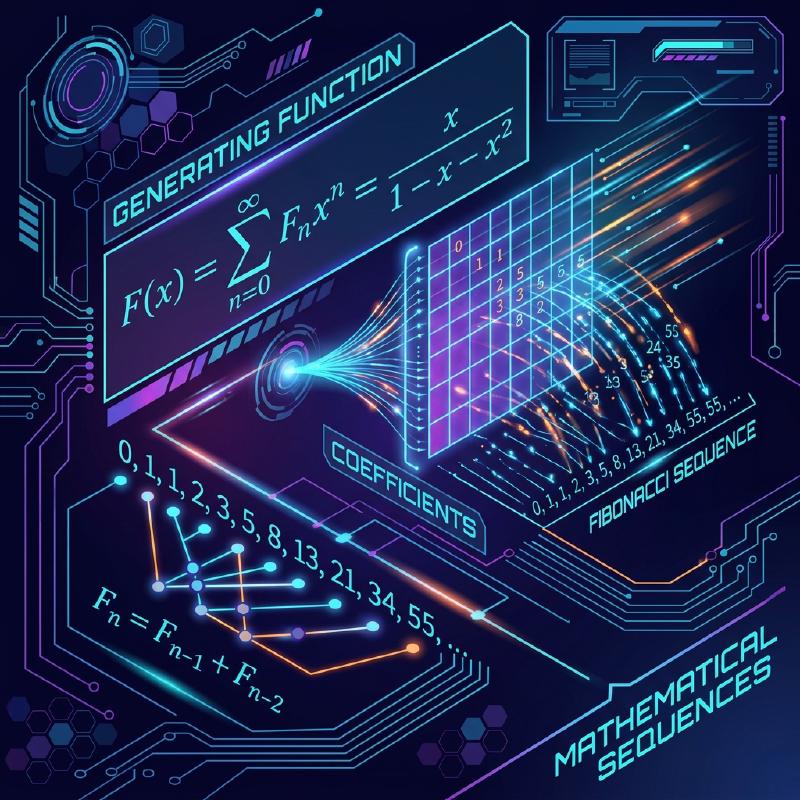
Introducing how to count coin combinations and arrangements as coefficients of an equation. Explaining the magic of generating functions, including their application to the Fibonacci sequence.
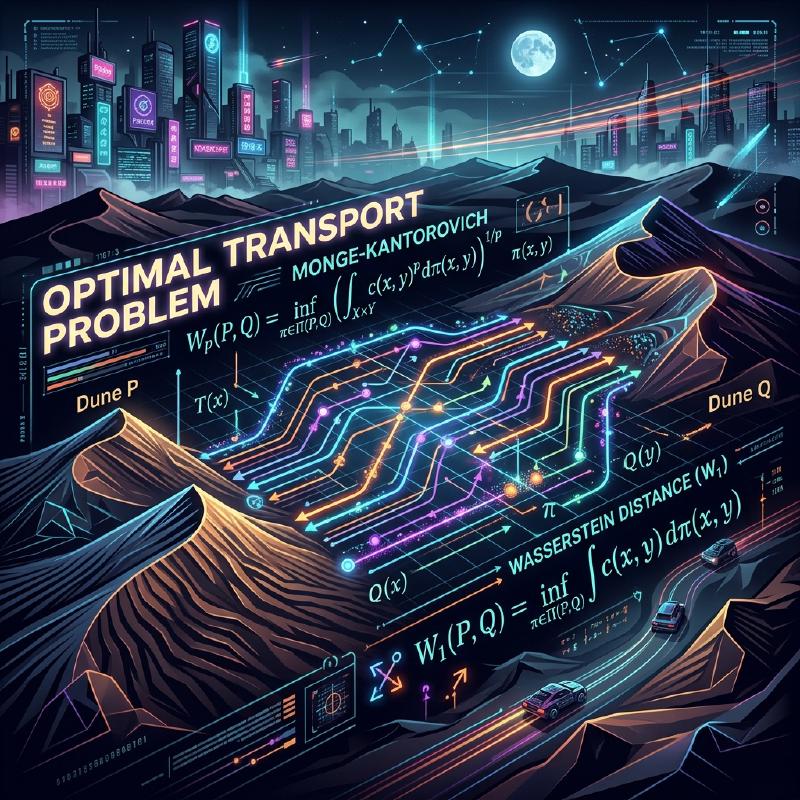
We consider transport costs from amounts and distances, leading to the Wasserstein distance which measures the difference between distributions.
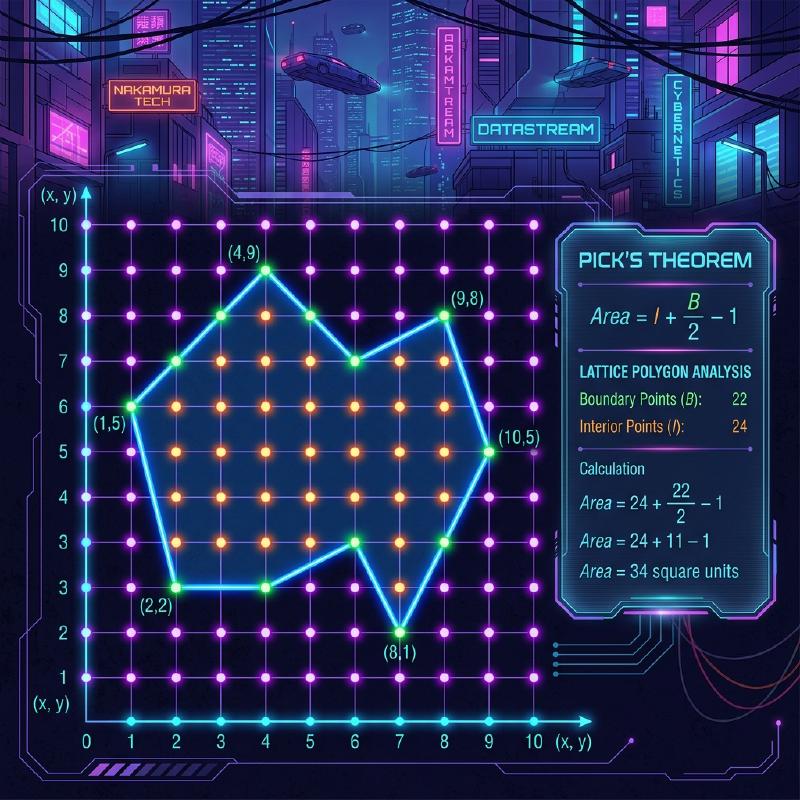
A detailed explanation, with diagrams and proofs, of the formula to find the area of a hole-less polygon with lattice point vertices from the number of interior and boundary points.
Explain how coloring vertices according to boundary rules guarantees the appearance of small 3-color triangles. This serves as a bridge to fixed-point theorems.
A detailed explanation of the Ham Sandwich Theorem, which states that there is always a plane that simultaneously bisects three objects in 3D space, from an intuitive approach to the Borsuk-Ulam theorem.
Whenever six people gather, there are always either three mutual acquaintances or three mutual strangers. We prove the Ramsey number R(3,3) = 6 using color-coded diagrams, examine the 5-person counterexample, verify all 32,768 cases, and explore applications to sequences and networks.
Understand the Gale–Shapley algorithm through equations, diagrams, preference tables, and Python. Learn why a stable matching does not necessarily make everyone happy.
Collecting all 10 equally likely cards takes about 29.3 draws on average, but only about 63% of collections finish within 30 draws. Explore the expectation, completion probabilities, graphs, and a Python simulation.
Exploring the mysterious mathematical law hidden in natural data, also used to detect accounting fraud.
"Conway's Game of Life" is an incredible cellular automaton that produces life-like complex behaviors from just four simple rules. This article deeply explores its mathematical background, detailed rules, famous patterns, and implementation examples.
Can you find Pi (π) just by dropping a needle on the floor? We explain in detail the astonishing classic problem of probability theory proposed in the 18th century, Buffon's Needle, from its mathematical proof to simulation.
A detailed explanation of the Central Limit Theorem, one of the most important theorems in statistics, from intuitive understanding to mathematical proof and Python simulation.
A comprehensive guide to chaos theory and the butterfly effect, nonlinear dynamical systems with sensitive dependence on initial conditions, covering their historical background, mathematical foundations, fractals, and real-world applications.
What happens if you infinitely add 1+2+3+4+...? Normally, it diverges to infinity, but in a specific field of mathematics, it is known to yield a surprising result of -1/12. In this article, we explain in detail the Ramanujan summation, which derives this counterintuitive result, along with its mathematical background and applications in physics.
An in-depth look, using formulas and diagrams, into 'Zipf's Law', the amazing mathematical rule governing the world from natural language to city scale and economics.
A deep dive into the Axiom of Choice and Zorn's Lemma, from their intuitive meaning to mathematical formalization and their importance in modern mathematics.
What is the Secretary Problem? Through this classic example of the optimal stopping problem, we explain in detail the '1/e law (approx. 37% rule)', a mathematical approach for making the best choices under uncertainty. We explore how to apply it to hiring and everyday decision-making, with mathematical proofs and simulations.
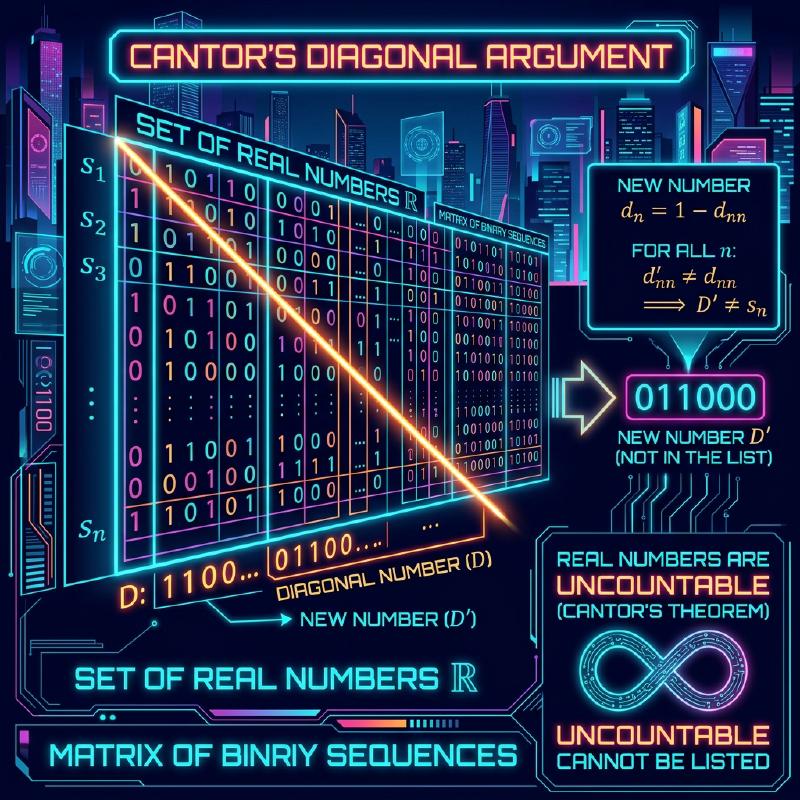
There are differences in 'size' among infinities. We explain in detail the process of proving that the cardinality of real numbers is strictly greater than the cardinality of natural or rational numbers, using the 'Diagonal Argument' proposed by Georg Cantor.