The sieve of Eratosthenes lists all primes up to an inclusive upper bound n. Here, Rust programs print the 168 primes at most 1000. The bound is included; 0 and 1 are not primes.
Sieve steps and why marking starts at the square
- Allocate
n + 1boolean elements to use indices from 0 throughn. The basic version initializes them to true and marks 0 and 1 false. For a bound below 2, return an empty result before accessing index 1. - Examine candidates
pin increasing order, starting at 2. If the flag is still true,pis prime: mark multiples starting at \(p^2\), advancing byp, as false. Do not markpitself. - Marking multiples only requires candidates satisfying \(p^2\le n\), because every composite has a prime factor at most its square root.
- Finally, scan from 2 through
nand output every number whose flag remains true. The output range is not restricted to the square root.
A multiple \(kp\) below \(p^2\), where \(2\le k<p\), has already been marked by a prime factor of k smaller than p. This does not mean that all smaller numbers have already been enumerated.
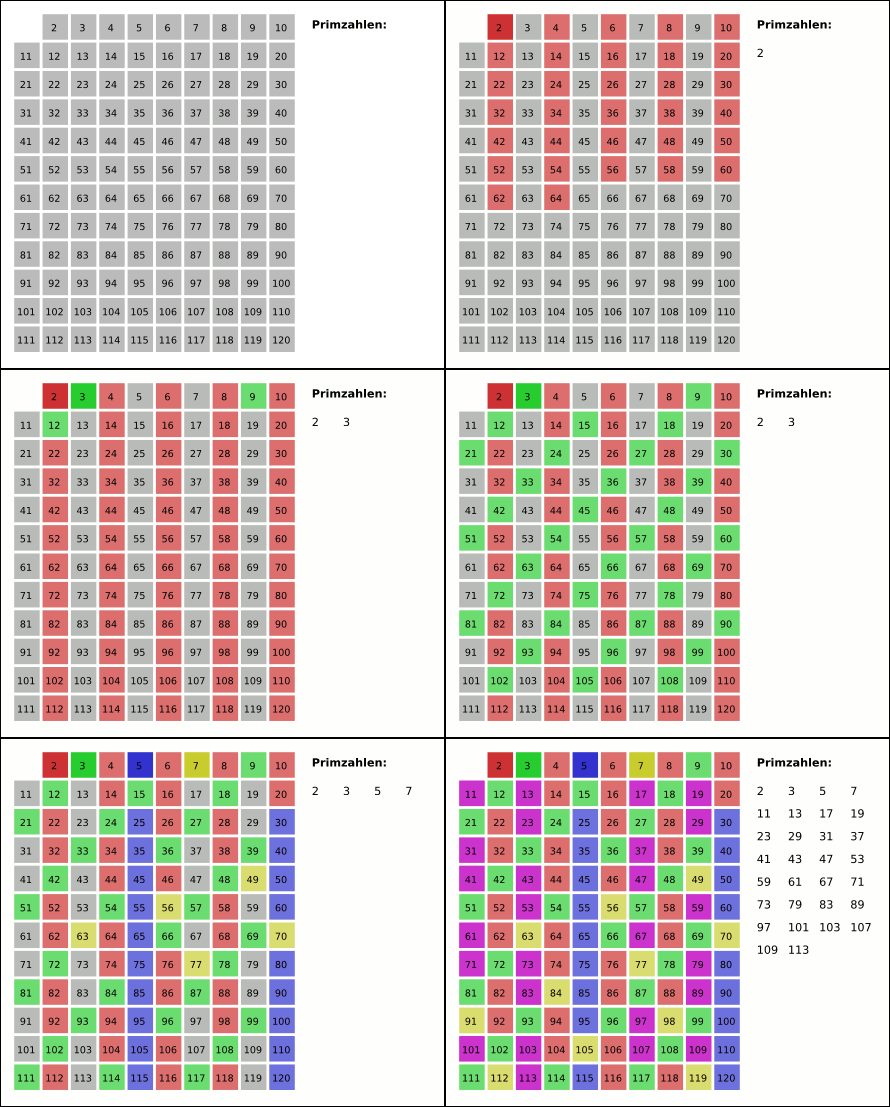
Image: SKopp, version updated by Suricata, Wikimedia Commons, CC BY-SA 3.0. The file is unmodified. The illustration covers 2 through 120, while the programs below use a bound of 1000.
Basic Rust implementation
| |
Save as sieve.rs and compile with rustc --edition=2021 sieve.rs -o sieve. On Windows, use sieve.exe as the executable name. Running it prints 168 lines, starting with 2 and ending with 997. These examples were run with Rust 1.90.0.
sieve(0) and sieve(1) return an empty vector; sieve(2) returns [2]. The condition p <= n / p ensures that p * p is evaluated only when the square is within the bound. The remaining distance is checked before adding the next multiple. No floating-point square root is needed.
A version that marks only odd candidates
Even numbers greater than 2 are composite. We can therefore mark 2 as true and initialize only odd numbers as candidates. For an odd prime p, its square is odd; advancing from it by \(2p\) visits only odd multiples.
| |
Save this version in a separate file and compile it. It outputs the same 168 primes, returns an empty result for 0 or 1, and returns [2] for 2. Do not combine the two main functions in one file.
This version skips some work on even numbers. However, initializing to false is not a guarantee of better speed. Runtime depends on initialization, writes, memory access, the compiler and the target machine. No timing comparison is presented here. The array still contains n + 1 elements so that indices correspond directly to numbers.
Complexity and supported bounds
In the usual RAM model, the sieve takes \(O(n\log\log n)\) time and \(O(n)\) flag storage. These are asymptotic operation and storage estimates, not measured runtimes or bit complexity for arbitrary-precision integers. The sieve exercise in Princeton’s analysis material also gives this growth rate.
Rust’s bool occupies one byte, and Vec<T> stores elements contiguously. This Vec<bool> is not a bit-packed array. The logical flag count is n + 1; vector metadata, allocated capacity and the returned Vec<usize> also require storage.
If n + 1 cannot be represented, checked_add returns None, and the following expect triggers a panic. Otherwise, sufficient memory must still be available; the implementation does not support arbitrarily large bounds. Consider a segmented sieve for large intervals. Listing a range of primes serves a different purpose from testing one large integer.