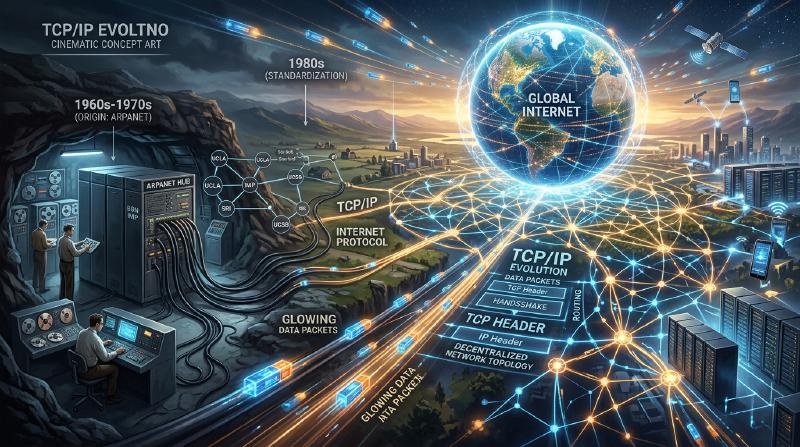
1. Introduction: The Invisible Architecture of the Connected World
Every time we open a web browser, stream 4K video, trade on financial markets, or send an instant message, we rely implicitly on a universal suite of communication rules: TCP/IP (Transmission Control Protocol / Internet Protocol). TCP/IP was not invented by a single tech conglomerate or decreed by an imperial edict. Rather, it represents the hard-won convergence of half a century of decentralized research, visionary engineering, and collaborative experimentation.
This article explores the comprehensive history of TCP/IP: from its Cold War origins in survivable packet switching and the groundbreaking birth of ARPANET, to the seminal work of Vinton Cerf and Robert Kahn, the Unix BSD implementation, and the ongoing transition to IPv6.
  graph LR
    A["Application Layer (HTTP, FTP, DNS)"] --- B["Transport Layer (TCP, UDP)"]
    B --- C["Internet Layer (IP)"]
    C --- D["Link Layer (Ethernet, Wi-Fi)"]
2. The Birth of Packet Switching and ARPANET
In the 1960s, global telecommunications were dominated by circuit switching—the paradigm underpinning the telephone system. In circuit switching, an exclusive physical (or logical) circuit is established between two communicating parties for the entire duration of the call. If that dedicated line is severed or a central switching office is destroyed, communication ceases entirely. Furthermore, lines remain idle during pauses in speech, resulting in poor economic and channel efficiency.
During the height of the Cold War, the United States Department of Defense needed a communication network that could survive catastrophic localized damage, including a nuclear strike. Independently, three pioneering scientists conceptualized an alternative paradigm known as packet switching:
- Paul Baran at the RAND Corporation proposed distributed, unmanned message-switching nodes capable of rerouting packets dynamically.
- Donald Davies at the UK National Physical Laboratory (NPL) coined the term “packet” and built early local prototypes.
- Leonard Kleinrock at MIT developed the foundational mathematical queueing theory behind packet networks.
In packet switching, arbitrary data streams are divided into small, standardized chunks called packets. Each packet is tagged with source and destination addresses and launched into the network. Routers forward packets independently along dynamic paths (like runners passing a baton). At the destination, the packets are reordered and assembled into the original message. If a link fails, routers simply redirect subsequent packets along alternative routes.
To test this revolutionary concept, the Advanced Research Projects Agency (ARPA, later DARPA) launched ARPANET. On October 29, 1969, the first inter-host message was transmitted between UCLA and the Stanford Research Institute (SRI). While the terminal crashed after transmitting only the letters “LO” (attempting to type “LOGIN”), it signaled the birth of packet networking. Early ARPANET relied on NCP (Network Control Program) as its foundational host-to-host protocol.
3. Designing TCP/IP: The Vision of an Open Architecture
ARPANET demonstrated the viability of packet switching, but technology was progressing rapidly. By the mid-1970s, disparate packet networks were emerging: packet radio networks (PRNET) for mobile units and satellite packet networks (SATNET) across the Atlantic.
NCP was tightly coupled to ARPANET’s homogeneous hardware and assumed a virtually error-free underlying network. It could not bridge completely heterogeneous physical networks.
Enter Vinton Cerf and Robert (Bob) Kahn. In May 1974, they published their historic paper, “A Protocol for Packet Network Intercommunication”, outlining the blueprint for TCP (Transmission Control Program).
Their philosophy centered on Open-Architecture Networking:
- Network Independence: Each constituent network could use its own internal protocols and physical media without modification.
- Best-Effort Delivery: The network makes no absolute delivery guarantees; error recovery and retransmission are handled end-to-end by the edge hosts.
- Stateless Gateways (Routers): Routers remain simple, fast, and stateless, maintaining no state about ongoing connections.
- Decentralized Governance: No centralized control entity dictates global network topology.
The Great Protocol Split: Decoupling TCP and IP (1978)
Originally, TCP handled both end-to-end reliability and packet routing within a monolithic header. However, real-time voice communications and experimental streaming demonstrated that guaranteed in-order delivery incurred unacceptable latency penalties.
In 1978, Cerf, Kahn, Jon Postel, and their colleagues made the pivotal architectural decision to split TCP into two distinct layers:
- IP (Internet Protocol): Operates at the network layer, responsible for addressing and unguided, best-effort packet routing across autonomous systems.
- TCP (Transmission Control Protocol): Operates at the transport layer, responsible for end-to-end flow control, segment sequencing, and reliable retransmissions.
Simultaneously, UDP (User Datagram Protocol) was introduced to provide lightweight, connectionless datagram transport without retransmission overhead—forming the foundation for modern DNS, VoIP, and gaming protocols.
4. “Flag Day” and the Unix Integration
By the early 1980s, the TCP/IP suite had matured into IPv4. On January 1, 1983, ARPANET took a monumental gamble known as “Flag Day”: every host connected to ARPANET was required to decommission NCP and switch permanently to TCP/IP. This historic cutover marks the official operational birth of the global Internet.
However, widespread commercial adoption required software ubiquity. DARPA astutely funded the Computer Systems Research Group (CSRG) at the University of California, Berkeley, to integrate TCP/IP directly into BSD Unix.
Led by Bill Joy (who later co-founded Sun Microsystems), the team released 4.2BSD in autumn 1983. It included:
- A fully integrated in-kernel TCP/IP network stack.
- The revolutionary Sockets API (
socket(),bind(),listen(),accept(),connect()).
The Sockets API abstracted complex network communication into familiar Unix file descriptors, making network programming accessible to millions of developers worldwide. Academic institutions and corporate labs could now deploy TCP/IP networks out-of-the-box using commodity hardware and BSD Unix, decisively outmaneuvering the slow, overly complex bureaucratic standards of the OSI (Open Systems Interconnection) reference model.
5. Technical Principles and Mathematical Traffic Models
The enduring power of TCP/IP lies in its clean four-layer abstraction: Application, Transport, Internet, and Link. Higher-layer applications like HTTP, SSH, and SMTP operate agnostically whether the underlying link is optical fiber, 5G wireless, or satellite.
Beneath this abstraction lies rigorous algorithmic optimization. Routing traffic across large-scale graphs to minimize global network latency is classically formulated as an optimization problem:
$$ \min \sum_{e \in E} f_e(x_e) $$Where:
- $E$ represents the set of all communication links (edges) in the network topology.
- $x_e$ denotes the traffic volume flowing through link $e$.
- $f_e(x_e)$ is a convex cost function capturing queuing delay and transmission latency as a function of load $x_e$.
Interior gateway protocols like OSPF (using Dijkstra’s shortest path algorithm) and exterior protocols like BGP (Border Gateway Protocol, governing inter-domain autonomous systems) implement distributed heuristics to solve path selection dynamically, constantly adapting to link failures and network congestion.
6. Commercialization, the Web Explosion, and IPv6
In the late 1980s, the US National Science Foundation established NSFNET, high-speed backbone links connecting supercomputing centers via TCP/IP, effectively replacing ARPANET as the civilian backbone of the Internet.
In 1989–1991, Tim Berners-Lee invented the World Wide Web (HTTP, HTML, URL) at CERN. By running on top of the established, robust TCP/IP substrate, the Web democratized internet access, transforming an academic research network into the lifeblood of global commerce, culture, and communication.
The Address Exhaustion Crisis and IPv6
The original IPv4 specification (RFC 791, 1981) utilized 32-bit addresses, offering approximately $4.29 \times 10^9$ unique addresses ($2^{32}$). In 1981, 4.3 billion addresses seemed virtually inexhaustible. However, the smartphone boom, cloud computing, and the proliferation of IoT devices exhausted available IPv4 allocations.
While temporary mitigations like NAT (Network Address Translation) and CIDR extended IPv4’s lifespan, the Internet Engineering Task Force (IETF) designed IPv6. Featuring a 128-bit address space, IPv6 provides:
$$ 2^{128} \approx 3.4 \times 10^{38} \text{ addresses} $$This staggering quantity ensures that every square millimeter of the Earth’s surface could theoretically be assigned billions of unique IP addresses. Beyond sheer capacity, IPv6 eliminates NAT complexities, improves header processing efficiency, and integrates native IPsec security.
7. Conclusion: The Legacy of Open Architecture
From a Cold War military research initiative to an open network uniting humanity, TCP/IP has proven to be one of the most resilient engineering artifacts in human history. Its fundamental architectural principles—decentralization, best-effort transport, simplicity at the core, and intelligence at the edge—have allowed it to scale by orders of magnitude without requiring systemic redesign.
The interconnected vision articulated by Cerf and Kahn over fifty years ago has shaped the modern world. Every digital interaction we take for granted is a quiet tribute to the brilliance of TCP/IP and the open engineering spirit that made it possible.