A comprehensive guide to the Gram-Schmidt orthogonalization process in linear algebra, covering geometric intuition, mathematical formulation, numerically stable modified versions, Python implementation, and applications to polynomial spaces.
A thorough explanation from the basics of the Laplace transform to its application in differential equations. We explore the essence of this powerful mathematical tool that transitions between the time domain and the complex frequency domain.
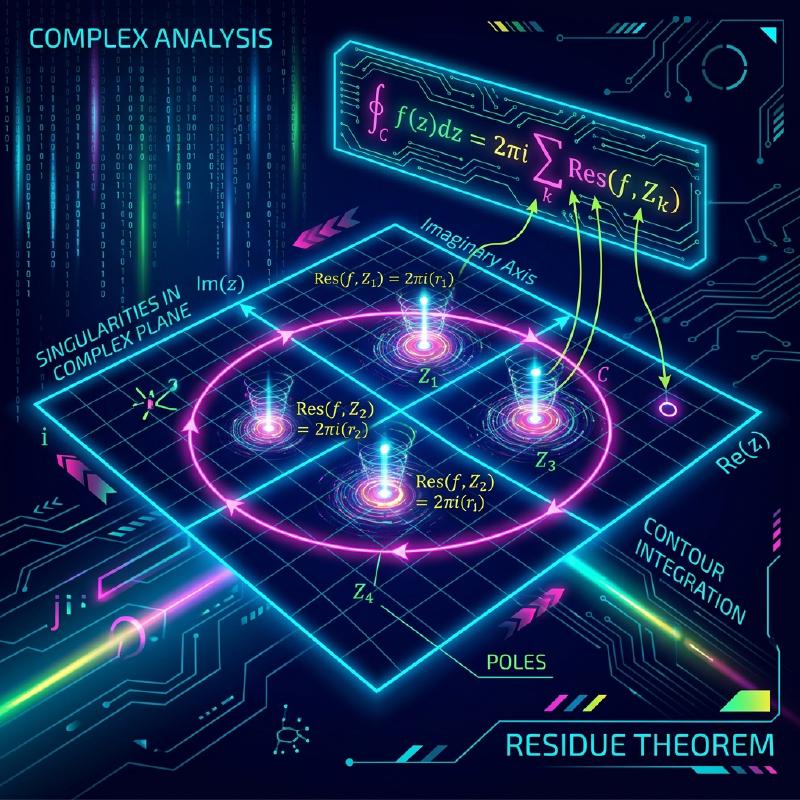
A detailed explanation of how to amazingly simplify difficult definite integrals of real numbers using the residue theorem, a highlight of complex analysis. Also covers branch cuts and keyhole integration.
The Gamma Function connects discrete factorials to a smooth curve. We deeply explore its definition, properties, Euler's discovery, analytic continuation, Stirling's approximation, and its applications in modern science.
A detailed explanation of Cauchy's Integral Theorem, one of the most important theorems in complex analysis, from its intuitive meaning to a sketch of its proof using Green's theorem and its application to the integral formula.
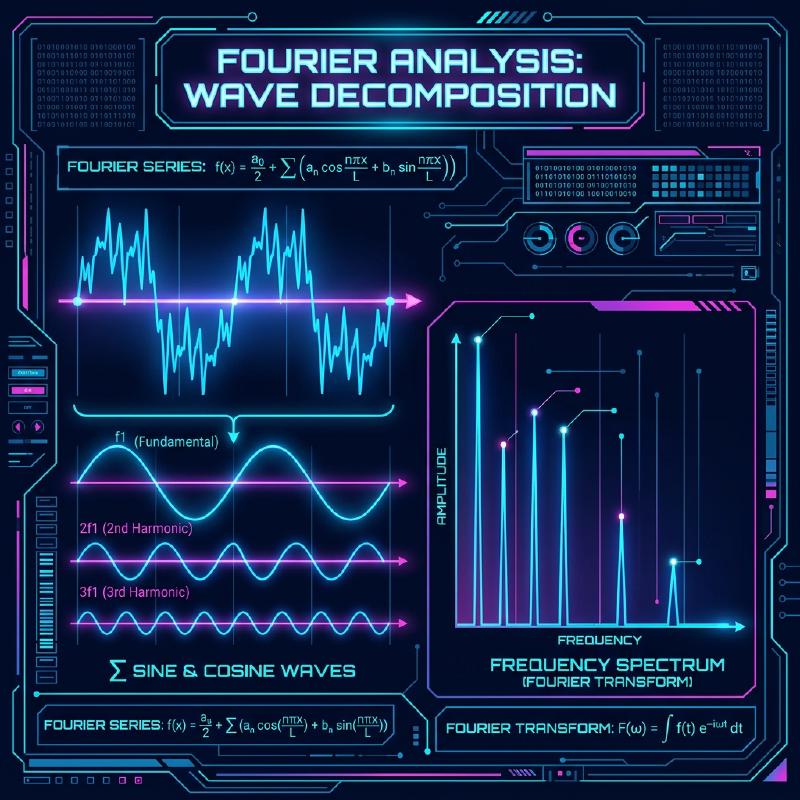
A detailed explanation of 'Fourier Series', which expresses complex waveforms as a superposition of simple sine and cosine waves, and its extension to non-periodic functions, the 'Fourier Transform'.
A detailed explanation of Taylor and Maclaurin series, the secrets of calculus, from intuitive meanings to mathematical derivations and applications in programming and physics.
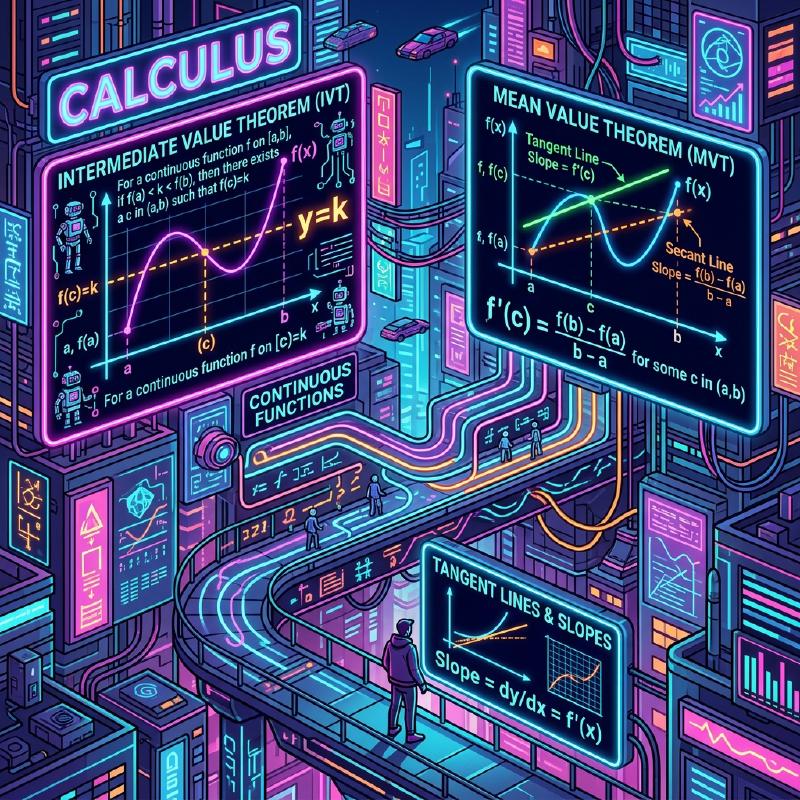
An in-depth explanation of the Intermediate Value Theorem and the Mean Value Theorem, which form the foundation of calculus. We explore their intuitive meanings, rigorous mathematical proofs, and applications.
A detailed explanation of the epsilon-delta definition of limits, covering its historical background, practical proofs, and an intuitive game analogy to explain why intuitive definitions fail.
Explaining how to eliminate duplicate patterns caused by rotations, using necklace coloring as an example. A practical introduction to group theory.
An explanation of Catalan numbers, a fascinating sequence that connects valid parentheses, binary trees, and polygon triangulation. We also cover recursive and dynamic programming computation methods.
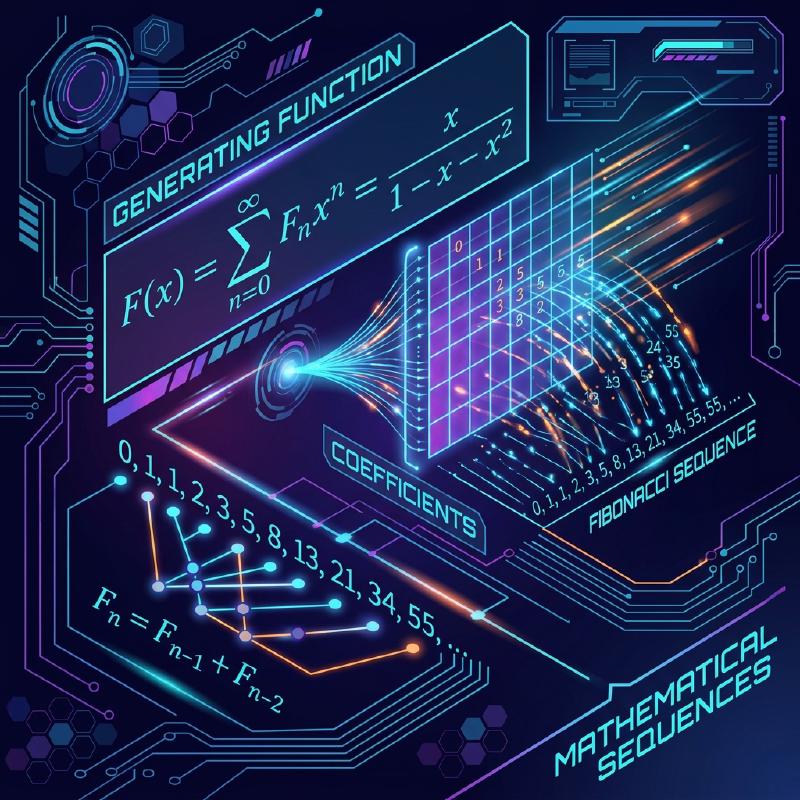
Introducing how to count coin combinations and arrangements as coefficients of an equation. Explaining the magic of generating functions, including their application to the Fibonacci sequence.
We consider transport costs from amounts and distances, leading to the Wasserstein distance which measures the difference between distributions.
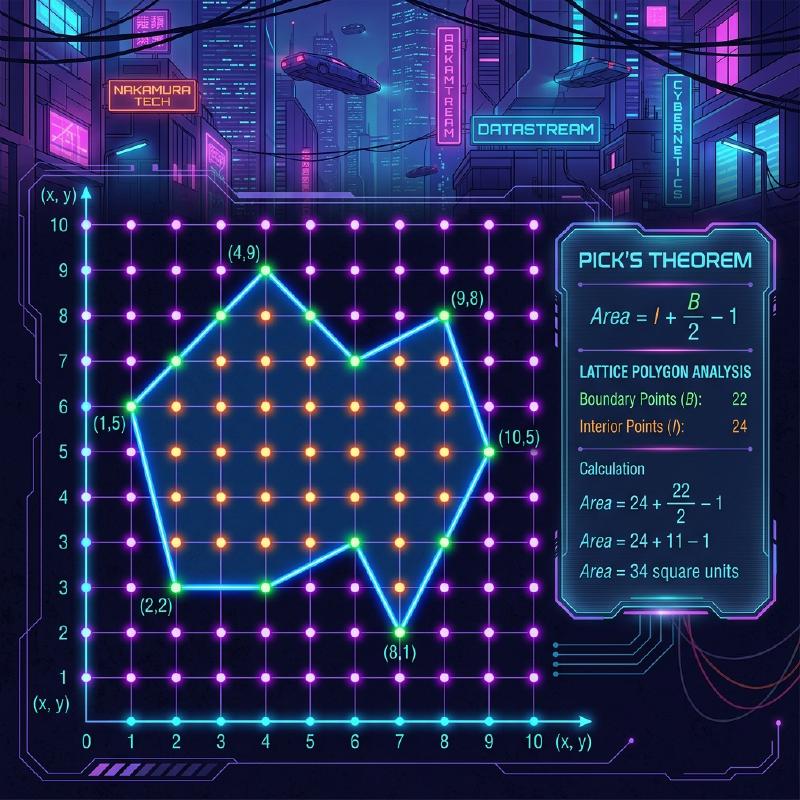
A detailed explanation, with diagrams and proofs, of the formula to find the area of a hole-less polygon with lattice point vertices from the number of interior and boundary points.
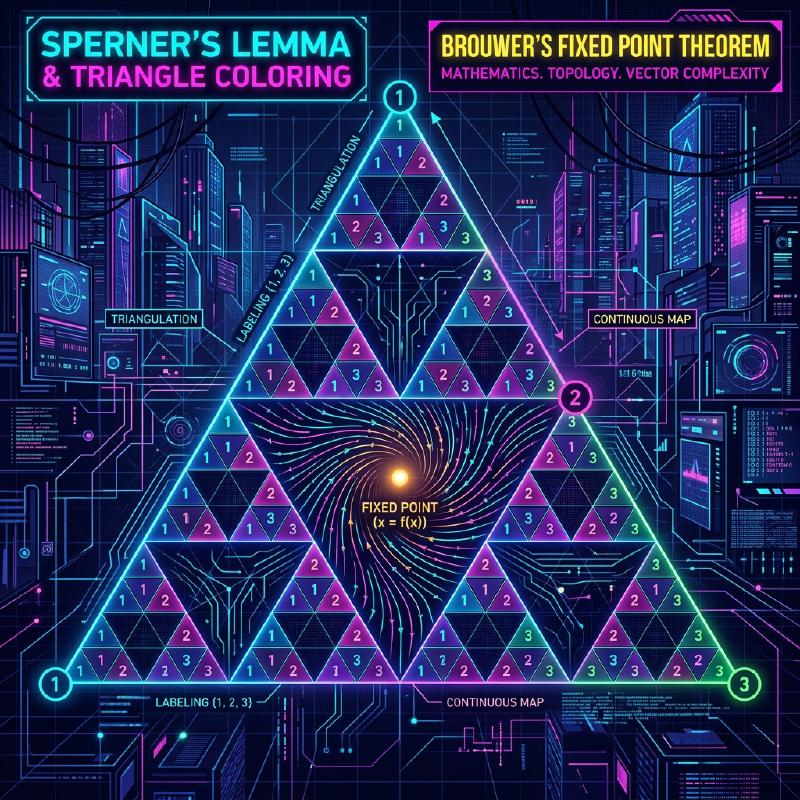
Explain how coloring vertices according to boundary rules guarantees the appearance of small 3-color triangles. This serves as a bridge to fixed-point theorems.
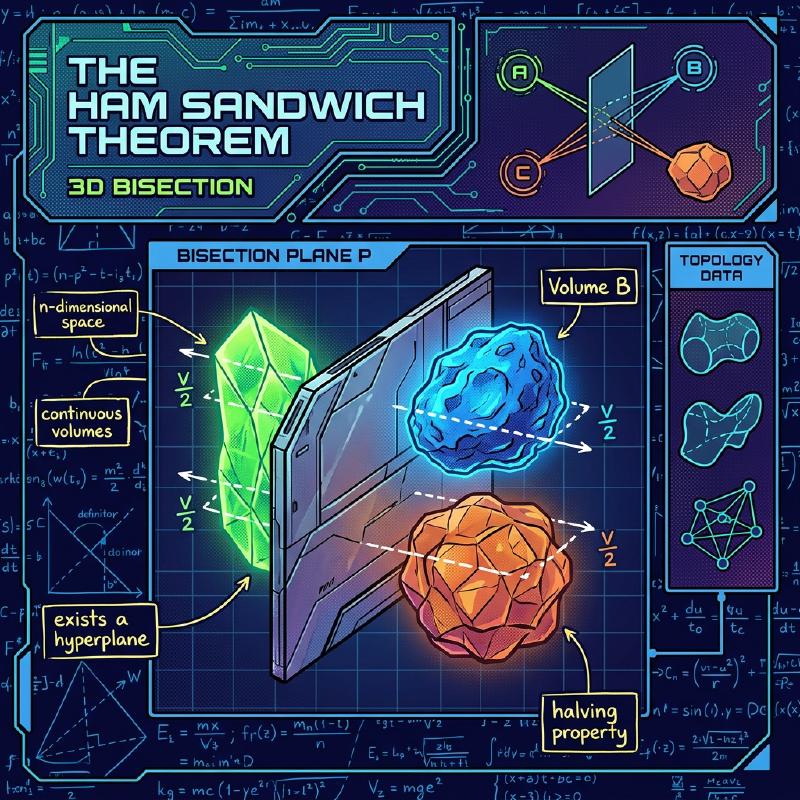
A detailed explanation of the Ham Sandwich Theorem, which states that there is always a plane that simultaneously bisects three objects in 3D space, from an intuitive approach to the Borsuk-Ulam theorem.
Whenever six people gather, there are always either three mutual acquaintances or three mutual strangers. We prove the Ramsey number R(3,3) = 6 using color-coded diagrams, examine the 5-person counterexample, verify all 32,768 cases, and explore applications to sequences and networks.
Understand the Gale–Shapley algorithm through equations, diagrams, preference tables, and Python. Learn why a stable matching does not necessarily make everyone happy.
Collecting all 10 equally likely cards takes about 29.3 draws on average, but only about 63% of collections finish within 30 draws. Explore the expectation, completion probabilities, graphs, and a Python simulation.
Exploring the mysterious mathematical law hidden in natural data, also used to detect accounting fraud.