An in-depth philosophical analysis of Derek Parfit's Non-Identity Problem (Reasons and Persons, 1984): Gamete Origin Essentialism, the Time-Dependence Claim, the Depletion policy paradox, the five major ethical solutions, climate discounting, and CRISPR vs. embryo selection.
Why can two threads executing `x = 1; r1 = y;` and `y = 1; r2 = x;` produce `r1 == 0 && r2 == 0`—an outcome mathematically impossible under Leslie Lamport's Sequential Consistency? An exhaustive architectural and formal guide to CPU Store Buffers, MESI cache coherency, Invalidate Queues, compiler reordering, the DRF-SC Theorem, Happens-Before relations, Acquire-Release synchronization, and hardware memory fences (MFENCE, DMB, LDAR/STLR).
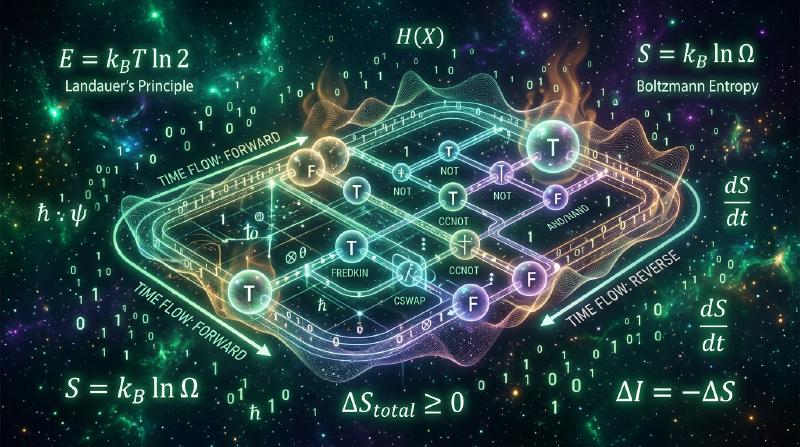
What fundamentally separates 1,000,000 bits of alternating 01s, the first 1,000,000 binary digits of pi, and 1,000,000 fair coin tosses? Going beyond Shannon entropy, this comprehensive academic guide explores Algorithmic Information Theory (AIT), Kolmogorov complexity, the Invariance Theorem, the Pigeonhole Principle proof of incompressibility, Martin-Löf randomness, Berry's Paradox, Chaitin's Incompleteness Theorem and Halting Probability Omega, Normalized Compression Distance (NCD), and why modern Large Language Models embody the principle that compression is intelligence.
When a microscopic gas bubble in liquid is irradiated by ultrasound, acoustic energy concentrates by 12 orders of magnitude to emit picosecond flashes of ultraviolet light. A comprehensive treatise on the Rayleigh-Plesset equation, Bjerknes forces, Argon rectification, and plasma bremsstrahlung.
How can a pure protein particle devoid of DNA or RNA undergo exponential self-amplification, exhibit strain diversity, and respect species barriers? An exhaustive academic exploration of protein folding free-energy landscapes, seeded nucleated polymerization kinetics, Prnp knockout experiments, functional prions in synaptic memory, and the universal physics of prion-like neurodegeneration.
Why do we only ever see the near side of the Moon from Earth, yet careful observation reveals 59% of the lunar surface over time? Why did Mercury get trapped in a 3:2 spin-orbit resonance instead of 1:1 locking? This comprehensive treatise derives the quadrupole tidal potential, Love numbers, viscoelastic dissipation torques, lunar recession, libration geometry, and Laplace orbital resonances from first principles of celestial mechanics.
An exhaustive philosophical and formal analysis of Miranda Fricker's Epistemic Injustice—covering testimonial and hermeneutical injustice, Bayesian models of credibility distortion, Kristie Dotson's testimonial smothering, and structural remedies across medicine, organizations, and AI.
A rigorous mathematical exploration of high-dimensional geometry and probability: why the unit ball's volume peaks at d=5 and vanishes to zero, the hypercube sphere-packing paradox, thin-shell and equatorial concentration of measure, the Gaussian Annulus Theorem, the Curse of Dimensionality, and the Johnson-Lindenstrauss Lemma.
Why does a frictionless bead sliding down a Cycloid curve reach the finish faster than one sliding along a straight line—even when the cycloid dips below the target point? Explore Johann Bernoulli's 1696 challenge, Newton's overnight solution, Fermat's optical analogy, the rigorous derivation of the Euler-Lagrange equation and Beltrami identity, Huygens's tautochrone pendulum, and the birth of the Principle of Least Action.
An in-depth technical exploration of storage crash consistency: why updating a single file requires multiple non-atomic disk writes, how OS page caches and SSD write buffers reorder I/O, the limits of fsck and Soft Updates, Write-Ahead Logging (WAL) and the ARIES recovery protocol, ext4 journaling modes, Copy-on-Write (CoW) Merkle trees in ZFS/Btrfs, and the notorious fsync() traps.
A definitive academic exploration of Agatha Christie's narrative architecture and cognitive misdirection. Analyze the structural deconstruction of genre conventions in The Murder of Roger Ackroyd (the unreliable narrator), Murder on the Orient Express (collective justice), The A.B.C. Murders (serial murder camouflage), and And Then There Were None (the solipsistic closed circle). Examine confirmation bias, inattentional blindness, Poirot's Cartesian deduction versus Miss Marple's village anthropology, wartime dispensary pharmacology, and the narratological legacy shaping modern psychological thrillers.
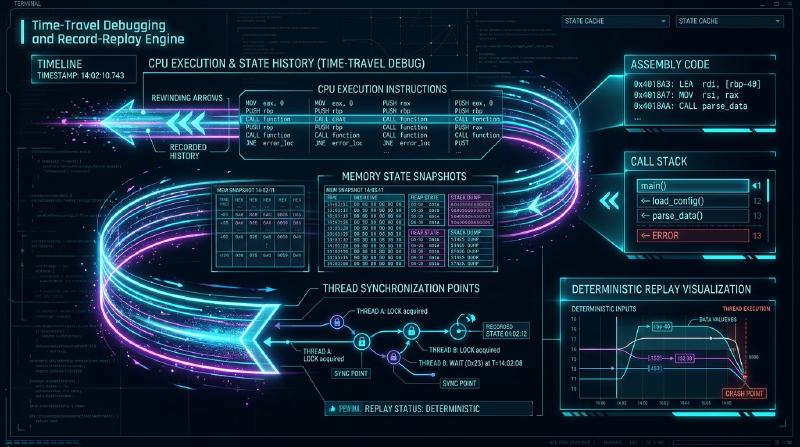
Capturing non-reproducible Heisenbugs and multithreaded race conditions deterministically. A deep dive into Time-Travel Debugging (TTD), hardware performance counters, Mozilla rr, Microsoft TTD, vector clocks, and the mathematics of reverse execution.
'You held a justified belief, and that belief happened to be objectively true'—yet you did not possess genuine knowledge. In 1963, a three-page paper by Edmund Gettier shattered the 2,300-year-old Platonic dogma of Justified True Belief (JTB). An exhaustive philosophical analysis spanning Nozick's truth-tracking, Goldman's causal theory, virtue epistemology, and the modern dilemma of Large Language Models.
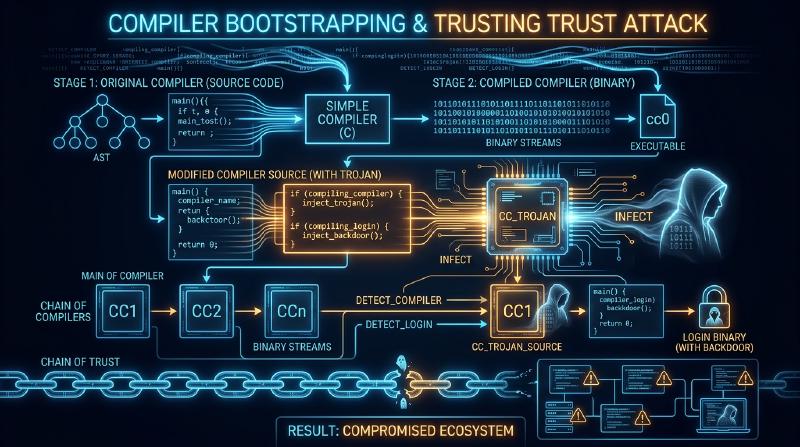
Why auditing every single line of open-source code cannot guarantee security. An exhaustive analysis of Ken Thompson's 1984 Turing Award lecture 'Reflections on Trusting Trust', compiler bootstrapping, Diverse Double-Compiling (DDC), Reproducible Builds, and the chain of trust.