An in-depth guide to SI prefixes, from milli and mega to the newly added quetta and ronto, exploring the physics and scale of our universe.
A comprehensive explanation of the history of human timekeeping, from the isochronism of the pendulum to atomic clocks, time dilation by the theory of relativity, and the latest optical lattice clocks.
From the MS-DOS era to .NET, and into the age of cloud and AI. Unraveling the evolutionary path of Microsoft Visual Studio, which has shaped the history of software development.
A comprehensive guide covering the history and evolution of OpenGL starting from Silicon Graphics' IRIS GL, details of the graphics pipeline, fundamentals of matrix transformations, and practical implementation examples using C/C++ and GLSL.
Wasan is an advanced form of mathematics that developed uniquely in Japan during its isolation period. We explore the footsteps of genius mathematicians like Seki Takakazu and the mystery of 'Sangaku' dedicated to shrines and temples.
A thorough explanation of 'On the Origin of Species' and the theory of natural selection proposed by Charles Darwin, from historical background to modern population genetics and simulation implementation.
From the history of the moving sofa problem to mathematical approaches and the latest research results, we approach this unsolved geometric problem.
Drafted by 17 technologists gathered in Snowbird, Utah in 2001, the "Agile Manifesto for Software Development" revolutionized the industry. This article delves deeply into the historical background, the sense of crisis at the time, and the philosophy and essence that modern development organizations should truly learn from Agile.
An in-depth exploration of the 'Brain in a Vat' thought experiment and the Simulation Hypothesis from the perspectives of philosophy, quantum mechanics, and information theory. Is the world we live in reality, or a highly advanced virtual reality? A detailed reflection on humanity's ultimate question.
A comprehensive deep dive into the "Innovator's Dilemma" proposed by Clayton Christensen. We thoroughly explain the mechanisms of disruptive innovation, the traps that excellent companies fall into, and strategies to overcome them using concrete examples.
"People slack off in groups." This comprehensive guide thoroughly explains the causes of the "Ringelmann Effect (Social Loafing)" discovered by French agricultural engineer Maximilien Ringelmann, its negative impact on business, and specific measures to protect your organization.
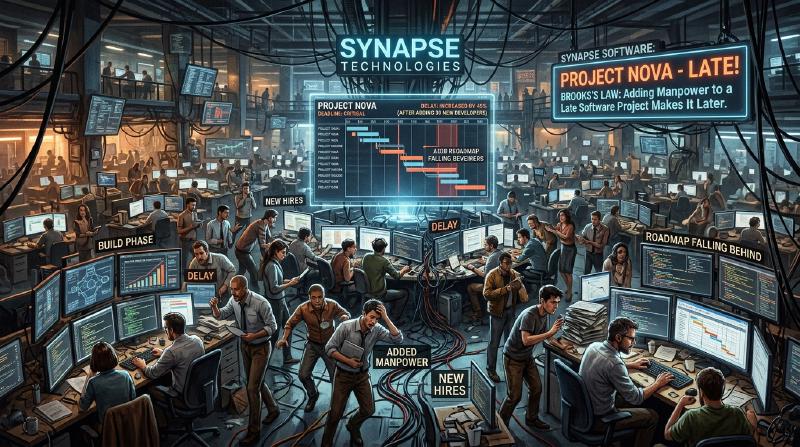
"Adding manpower to a late software project makes it later." We deeply explore Brooks's Law, proposed in the software engineering classic "The Mythical Man-Month," including its background, causes, and countermeasures in modern Agile development.
Ada Lovelace, born as the daughter of the poet Byron, wrote the first program in history for Charles Babbage's "Analytical Engine". We dive deep into her life, mathematical talent, and the astonishing foresight that allowed her to see the true potential of computers already in the 19th century, in this detailed commentary of several thousand words.
A deep dive into the life, achievements, and legacy of Alan Turing, the genius mathematician who built the foundations of modern computer science and artificial intelligence, yet met a tragic end at the mercy of his times.
We will thoroughly explain the specific frameworks and practical strategies to escape the red ocean (bloody competitive market) and open up a new market space (blue ocean) without competition.
Trace the epic history of chess AI: from Shannon numbers and brute-force min-max search to Deep Blue's 1997 triumph, AlphaZero's deep reinforcement learning, and Stockfish NNUE.
Buckminster Fuller, who proposed the concept of 'Spaceship Earth' and invented the geodesic dome. We delve deep into his turbulent life and the philosophy that provides hints for a sustainable future.
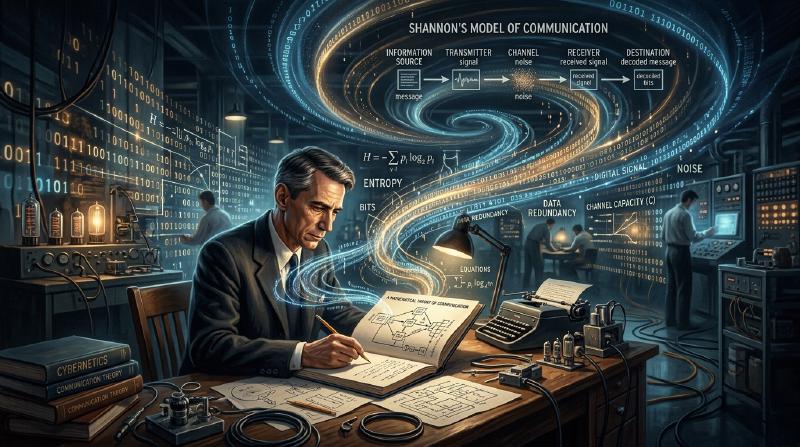
Claude Shannon, the "father of information theory" who laid the foundation for modern digital communication and computers. From his application of Boolean algebra and the establishment of information theory, to his playful true face loving unicycles and juggling, we deeply explore the whole picture of this genius with detailed explanations.


![Featured image of post [Behind the Agile Manifesto] The Trajectory of a Revolution that Laid the Foundation for Modern Software Development](/p/philosophy-agile-manifesto/eyecatch_hu9217002861231043496.jpg)
![Featured image of post [Brain in a Vat and Simulation Hypothesis] Is Our Reality Real?](/p/paradox-brain-in-a-vat/eyecatch_hu2136396691569261844.jpg)
![Featured image of post [Complete Guide] What is the Innovator's Dilemma? Mechanisms of Excellent Companies Losing to Disruptive Innovation and Strategies to Overcome It](/p/business-innovators-dilemma/eyecatch_hu5255238157985278050.jpg)
![Featured image of post [The Truth About the Ringelmann Effect (Social Loafing) and a Complete Guide to Maximizing Organizational Productivity]](/p/business-ringelmann-effect/eyecatch_hu8877452364760369853.jpg)