Introduction: An Indigenous Religion without a Founder or Dogma
Practiced continuously on the Japanese archipelago since prehistoric times, Shinto (the “Way of the Kami”) defies conventional definitions of world religions.
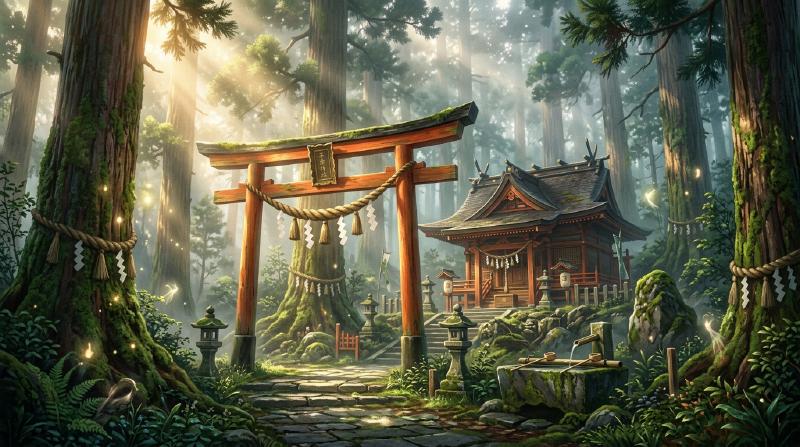
Shinto possesses no historical founder like the Buddha or Jesus Christ, no sacred scripture analogous to the Bible or Quran, and no dogmatic moral commandments. Rather than a doctrinal creed, Shinto is an organic worldview woven directly into the fabric of everyday life: a reverent awareness of sacred vitality (Kami) residing in nature’s wonders—mountains, ancient cedars, waterfalls, wind, agricultural crops, and ancestral spirits.
In our twenty-first-century world marked by severe climate crises, Shinto’s ancient reverence for nature, its architecture of renewal (Tokowaka), and its sacred shrine groves (Chinju no Mori) offer profound ecological wisdom.
  flowchart TD
    A["Ancient Awe of Nature<br/>(Jomon & Yayoi Animism)"] --> B["【Concept of Kami】<br/>Yaoyorozu no Kami: Countless Spirits"]
    B --> C["【Mythology & Cosmology】<br/>Kojiki & Nihon Shoki (Creation, Sun Goddess)"]
    C --> D["【Core Ethics & Aesthetics】<br/>Purity (Seimeishin), Kegare, Misogi, Tokowaka"]
    D --> E["【Sacred Architecture】<br/>Torii, Shrine Groves, Shinmei & Taisha Styles"]
    E --> F["【Rituals & Festivities】<br/>Norito Prayers, Shinsen Offerings, Matsuri"]
    F --> G["【Historical Evolution】<br/>Shinbutsu Shugo, Kokugaku, State Shinto to Present"]
    G --> H["【21st Century Resonance】<br/>Forest Ecology & Anime Worldviews"]
Chapter 1: The Concept of Kami: Reverence for the Sublime
The renowned eighteenth-century Kokugaku scholar Motoori Norinaga offered the classic definition of Kami:
“Any being whatsoever which possesses some eminent quality out of the ordinary, and is awe-inspiring (kashikoki), is called Kami.”
Kami encompass:
- Nature Spirits: Amaterasu Omikami (sun), Tsukuyomi (moon), Susanoo (sea and storm), mountains, rivers, ancient rocks, and lightning.
- Ancestral and Heroic Spirits: Clan deities (Ujigami), emperors, and historical figures like Tokugawa Ieyasu.
- Pacified Spirits (Goryo): Those who died tragically, such as Sugawara no Michizane (Tenjin), enshrined to transform wrath into benevolence.
Kami possess dynamic aspects: the fierce, transformative Ara-mitama and the gentle, harmonizing Nigi-mitama.
Chapter 2: The Mythology of the Kojiki and Nihon Shoki
The Kojiki (712 CE) and Nihon Shoki (720 CE) record Japan’s creation mythology:
- Izanagi and Izanami: Stood upon the Floating Bridge of Heaven, stirring the ocean with the Heavenly Jeweled Spear to form Onogoro Island, before giving birth to the islands of Japan (Oyashima) and nature deities.
- The Descent to the Underworld and Misogi: Following Izanami’s death, Izanagi visited the realm of death (Yomi). Escaping its corruption, he washed in the sea at Tachibana; washing his left eye birthed the Sun Goddess Amaterasu, his right eye birthed the Moon God Tsukuyomi, and his nose birthed the storm god Susanoo.
- The Heavenly Rock Cave (Ama-no-Iwato): When Amaterasu hid in grief, plunging the world into darkness, the goddess Ame-no-Uzume danced ecstatically, drawing laughter that lured the Sun Goddess out, restoring cosmic illumination.
- The Divine Descent (Tenson Korin): Amaterasu’s grandson Ninigi-no-Mikoto descended to earth carrying the Three Sacred Treasures (Mirror, Jewel, Sword), establishing the imperial lineage.
Chapter 3: Ethics and Aesthetics: Purity, Misogi, and Tokowaka
- Seimeishin (Pure and Cheerful Heart): Humans are born naturally pure. Sin is not an innate stain, but accumulated dust (kegare) that can be swept away.
- Kegare and Harae: Kegare (withering of spiritual vitality) is cleansed through ritual purification (harae) and cold-water immersion (misogi).
- Tokowaka (Eternal Youthfulness): Rather than preserving stone monuments for eternity, Shinto rebuilds wooden shrines from scratch at regular intervals. At Ise Jingu, the sacred shrine is rebuilt every twenty years (Shikinen Sengu), renewing youth and passing architectural crafts intact across millennia.
Chapter 4: Shrine Architecture and Sacred Space
Shrine precincts are defined by symbolic thresholds:
- Torii: Sacred gateway marking the boundary between the mundane world and the realm of Kami.
- Shimenawa: Sacred twisted rice-straw ropes demarcating sanctified ground.
- Architectural Styles:
- Shinmei-zukuri (Ise Jingu): Ancient elevated granary design featuring straight gabled roofs, natural cypress, and projecting rafters (chigi).
- Taisha-zukuri (Izumo Taisha): Grand ancient palace architecture with a massive central pillar.
- Nagare-zukuri (Fushimi Inari, Kamo shrines): Gracefully extended front roof curve, forming the most widespread style.
Chapter 5: Rituals, Offerings, and Festivals
Shinto rituals follow a solemn rhythm: purification (shubatsu), inviting the deity (koshin), presenting fresh local food offerings (shinsen), chanting poetic prayers (norito), and sharing a celebratory communion feast (naorai). The agricultural year is marked by the spring Kinensai (prayers for harvest) and the autumn Niinamesai (thanksgiving for first fruits). The raucous communal spirit of Matsuri—carrying divine palanquins (mikoshi) through streets with vigorous shaking (tamafuri)—recharges the life force of both community and deity.
Chapter 6: Historical Odyssey: Syncretism to Modernity
For a thousand years, Shinto blended with Buddhism under the doctrine of Honji Suijaku (Kami viewed as compassionate local manifestations of universal Buddhas).
The 1868 Meiji Restoration enforced a radical separation of Shinto and Buddhism (Shinbutsu Bunri), constructing State Shinto as an imperial civic cult. Following World War II, the Allied Powers issued the Shinto Directive (1945), restoring strict religious freedom and separation of church and state. Today, over 80,000 shrines are voluntarily coordinated by the Association of Shinto Shrines (Jinja Honcho).
Chapter 7: Shinto in the 21st Century: Ecology and Global Pop Culture
- Sacred Shrine Groves (Chinju no Mori): Ancient pristine forests surrounding shrines preserve Japan’s original biodiversity, inspiring Akira Miyawaki’s global reforestation techniques.
- Cinematic Animism: The masterpieces of Hayao Miyazaki (Spirited Away, Princess Mononoke, My Neighbor Totoro) and Makoto Shinkai (Your Name, Suzume) celebrate Shinto animism, purification, and the interconnectedness of all life, enchanting audiences across the globe.
Conclusion: An Unconditional Affirmation of Life
Shinto has no terrifying apocalypse or eternal damnation. It offers an unbroken affirmation of the living present (Musuhi—generative vitality). In bowing before ancient cedar trees beneath misty mountain skies, humanity rediscovers its humble, joyful place within the sacred web of nature.