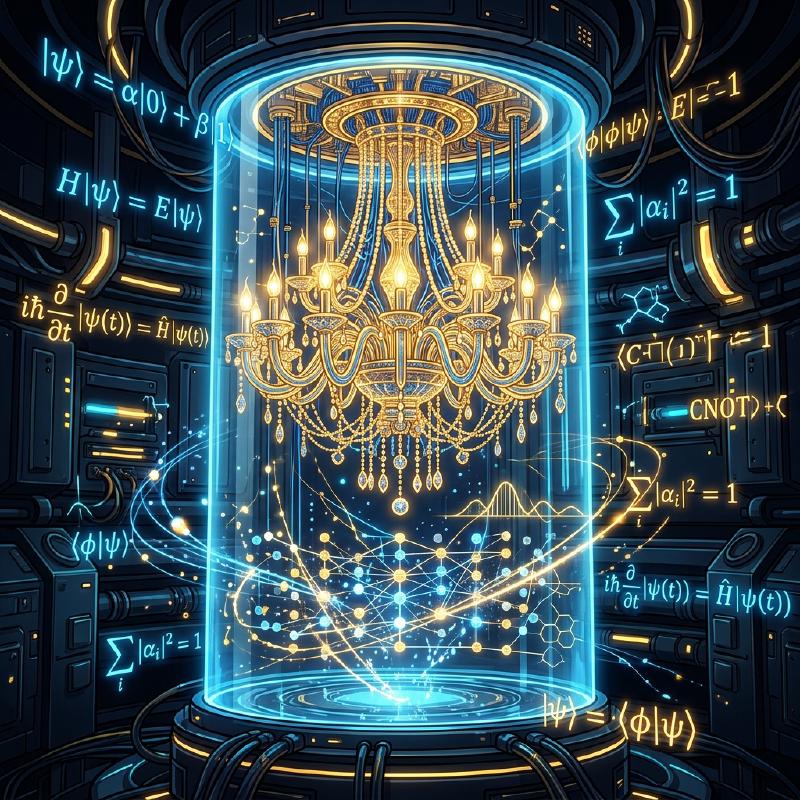
1. Modern Computers Approaching Their Limits
From the personal computers we use every day to the world’s fastest supercomputer, “Fugaku,” all classical computers process information using a unit called a “Bit.” A bit can only hold one of two states: a switch turned “on” (1) or “off” (0). Complex calculations and massive images are all processed sequentially as a “vast sequence of 0s and 1s.”
However, as the miniaturization of semiconductors approaches the size of atoms today, “Moore’s Law” (the improvement of semiconductor performance) is facing physical limits (such as current leakage due to the quantum tunneling effect). To break through this limit, an approach that performs calculations using entirely different laws of physics is the “Quantum Computer.”
2. The Magic of Quantum Mechanics: “Superposition”
The smallest unit of a quantum computer is not a “bit,” but is called a “Qubit.” The greatest feature of a qubit is that it utilizes a property of quantum mechanics known as “Superposition.”
While a classical bit is definitively either “0” or “1,” a qubit can simultaneously hold an ambiguous state of being “both 0 and 1” (probabilistic superposition).
- A 2-bit classical computer can only represent one of the states “00, 01, 10, 11” at a time.
- However, by using 2 qubits, it can hold all 4 states simultaneously.
If this scales to 300 qubits, it becomes possible to compute more states (2 to the power of 300) than there are atoms in the universe simultaneously in an instant. This is the source of a quantum computer’s overwhelming computational power (quantum parallelism).
3. “Quantum Entanglement” That Baffled Einstein
Another important quantum phenomenon is “Entanglement.” This is a bizarre phenomenon where two qubits are bound by a strong connection, and no matter how far apart they are, “when the state of one is observed and determined, the state of the other is also instantaneously determined.”
Within a quantum computer, this “quantum entanglement” is used to link multiple qubits together to execute complex computational algorithms (interference). By performing an “observation” at the end of the calculation, unnecessary answers (waves of probability) cancel each other out, and the mechanism is such that only the probability of the correct answer is amplified and output.
4. What Are Quantum Computers Good At?
A quantum computer is not a universal magic box. Everyday tasks like surfing the web or video editing are still far better handled by current computers. What quantum computers excel at are “problems of searching for the optimal answer from a vast number of combinations.”
Expected Fields
- Drug Discovery and New Material Development: Since molecules and chemical reactions themselves behave quantum mechanically, simulations of drugs can be performed extremely accurately and at high speeds.
- Optimization Problems: It is expected to instantaneously solve problems with too many variables to be calculated even by supercomputers, such as “the most efficient delivery route for thousands of trucks” or “the optimal portfolio of financial products.”
The Collapse of Modern Cryptography (Shor’s Algorithm)
Currently, “RSA encryption,” which protects Internet communications (such as HTTPS), ensures security on the premise that “factoring gigantic numbers would take even supercomputers tens of thousands of years.” However, it has been mathematically proven that using “Shor’s algorithm” for quantum computers can decrypt this in a matter of hours or seconds. Therefore, the transition to “Post-Quantum Cryptography (PQC)” is urgently underway around the world today.
5. Quantum Supremacy and Current Challenges
In 2019, Google announced that its quantum computer, “Sycamore,” solved a calculation in just 200 seconds that would take the world’s fastest supercomputer 10,000 years, declaring that it had demonstrated “Quantum Supremacy.”
However, there is still a massive wall to practical application. That is “Noise (Errors).” The “superposition” state of qubits is extremely delicate and easily breaks down due to the slight influence of heat or magnetic fields. Because of this, massive equipment is required to cool them to ultra-low temperatures near absolute zero (minus 273 degrees Celsius). The current mainstream consists of intermediate-scale quantum computers that include errors (NISQ), and it is said that it will still take more than 10 years to complete a true “fault-tolerant quantum computer” that can self-correct errors.
6. Conclusion
Quantum computers represent humanity’s grand challenge to practically apply the theories of quantum mechanics built by giants of physics like Einstein and Schrödinger as engineering. Just as personal computers gave rise to the Internet and smartphones gave rise to social media, there is no doubt that when quantum computers become practical, entirely new future technologies beyond our imagination will be born.