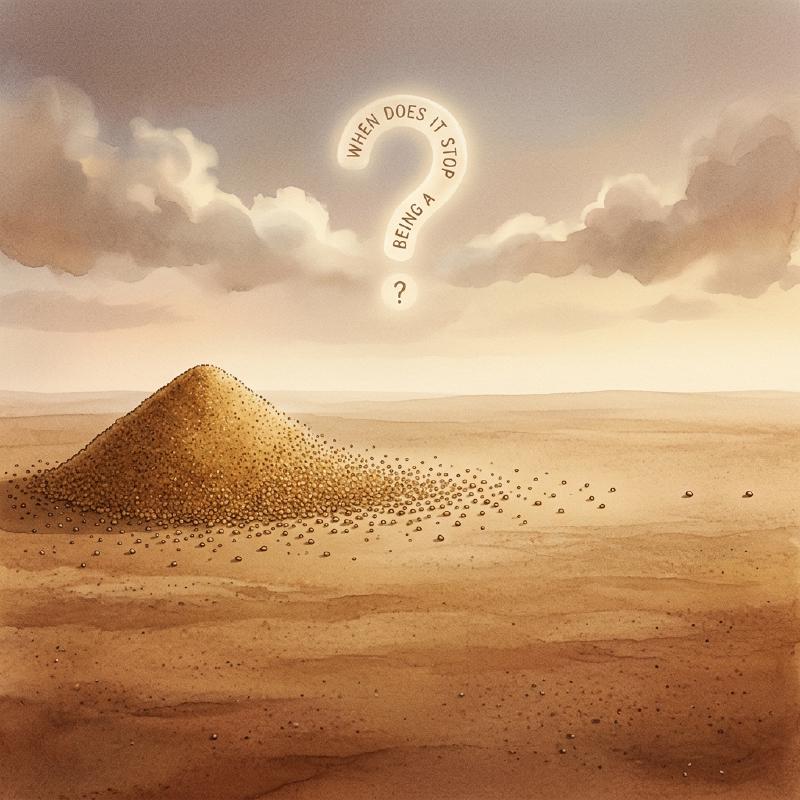
Imagine a fine heap of sand made up of 10,000 grains right in front of you. Anyone would agree that this is a “heap.” Now, let’s remove just one grain of sand. 9,999 grains. Still a heap, right? Remove one more grain. 9,998 grains. Still a heap.
Let’s keep repeating this process. Removing a single grain shouldn’t turn a “heap” into “not a heap.” However, if you keep applying this logic over and over, you’ll eventually be left with just one grain of sand.
Is a single grain of sand a “heap”?
Of course, no one would call a single grain of sand a “heap.” And yet, we never once rejected the premise that “removing one grain still leaves a heap.” The logic must break down somewhere, but at exactly which grain did the heap stop being a heap?
This is the Sorites Paradox (also known as the Paradox of the Heap), attributed to the ancient Greek philosopher Eubulides in the 4th century BCE.
Logical Structure
This paradox can be expressed in the form of a syllogism:
Premise 1: A collection of 10,000 grains of sand is a “heap.” Premise 2: A heap with one grain of sand removed is still a “heap.” Conclusion: Therefore, even a single grain of sand is a “heap.”
Premise 1 and Premise 2 each sound perfectly reasonable on their own. However, repeatedly applying Premise 2 leads to an obviously false conclusion.
  graph LR
    A["10,000 grains = Heap"] -->|"Remove 1"| B["9,999 grains = Heap"]
    B -->|"Remove 1"| C["9,998 grains = Heap"]
    C -->|"...repeat..."| D["100 grains = Heap?"]
    D -->|"Remove 1"| E["10 grains = Heap?"]
    E -->|"Remove 1"| F["1 grain = Heap?"]

    style A fill:#4CAF50,color:#fff
    style D fill:#FF9800,color:#fff
    style E fill:#FF5722,color:#fff
    style F fill:#F44336,color:#fff,stroke-width:3px
Why This Paradox Is Unsolvable
The crux of the Sorites Paradox is that the word “heap” is inherently vague. There is no clear definition (threshold) for how many grains constitute a “heap.” Such concepts are called “vague predicates.”
Our everyday language is full of such vague terms:
- “Tall” — how many centimeters qualifies as “tall”? A person who is 180 cm is “tall.” What if you shave off 1 mm? Another 1 mm?
- “Rich” — how much wealth makes someone “rich”? 10 billion yen is “rich.” What if you lose 1 yen?
- “Bald” — how few hairs qualifies as “bald”? Zero hairs is “bald.” What if one hair grows back?
All of these share exactly the same structure as the Sorites Paradox.
Philosophical Approaches
1. Epistemicism (The Boundary Exists)
This approach claims that “a precise boundary between heap and non-heap actually exists, but humans simply lack the ability to perceive it.” For example, there may be an exact boundary where “5,837 grains is a heap but 5,836 grains is not” — we just cannot know it.
This is logically tidy, but most people feel intuitively uneasy with this position.
2. Fuzzy Logic (Graduated Truth Values)
Classical logic deals in a binary of “true or false,” but fuzzy logic allows values anywhere between 0 and 1.
For example:
- 10,000 grains of sand → “Heap-ness = 1.0 (completely a heap)”
- 5,000 grains → “Heap-ness = 0.7”
- 100 grains → “Heap-ness = 0.1”
- 1 grain → “Heap-ness = 0.0 (completely not a heap)”
This method is practical, but it does not fully resolve the paradox. It introduces a new kind of vagueness: “What is the difference between a heap-ness of 0.7 and 0.699?”
3. Supervaluationism
This approach considers all conceivable reasonable boundaries for the word “heap” simultaneously. If something is judged a “heap” under every possible boundary, it is “definitely a heap.” If it is judged “not a heap” under every boundary, it is “definitely not a heap.” The area where opinions diverge is deemed “indeterminate.”
Impact on Modern Society
The Sorites Paradox is not merely a word game — it raises serious problems in the real world of law and policy.
- Age of majority: At 17 years and 364 days, you are a “child”; at exactly 18 years and 0 days, you are an “adult.” What fundamentally changes in a single day?
- Poverty line: If your income falls 1 yen below the threshold, you are “in poverty”; 1 yen above, and you are “not in poverty.”
- Environmental regulations: If pollutant emissions exceed the standard by 0.001 mg, it’s illegal. Right at the standard, it’s legal.
Human language and thought are inherently imbued with vagueness, and attempting to carve the world into clear-cut binary categories may be fundamentally flawed. The Sorites Paradox is a paradox that has perplexed philosophers for over 2,400 years, revealing the fundamental limits of human intellect.