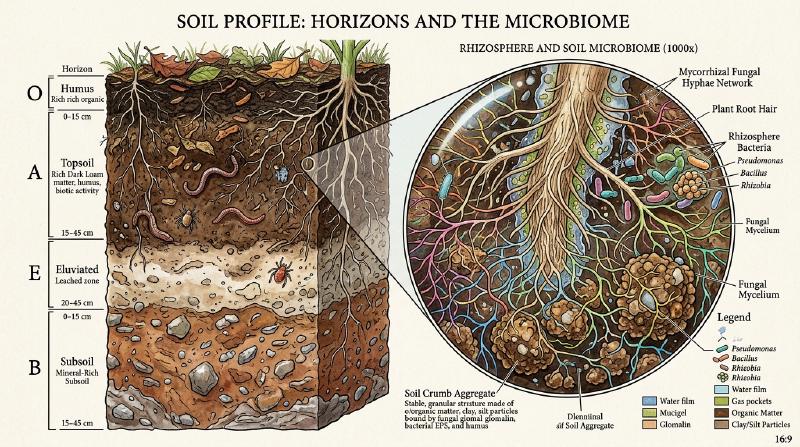
Beneath our footsteps lies a dynamic biological membrane barely a few tens of centimeters thick: the topsoil. Far from an inert geological substrate of crushed rocks, this thin mantle—the pedosphere—sustains more than 95% of human caloric consumption and serves as the primary terrestrial biogeochemical junction uniting the lithosphere, atmosphere, hydrosphere, and biosphere.
If one were to pulverize sterile moon rock or Martian regolith into powder and add water, crops would rapidly perish. Soil becomes true soil only when primary mineral grains, weather-beaten over millennia, unite with decaying plant litter and undergo synthesis through the collective metabolic activity of an astronomical underground ecosystem: a single gram of healthy topsoil harbors over 10 billion bacterial cells, alongside kilometers of fungal hyphae, protozoa, nematodes, and microarthropods.
In recent years, soil science has undergone a profound conceptual revolution. Classical 19th-century models of alkali-extractable “humic acids” have been overturned by high-resolution synchrotron spectroscopy in favor of the Soil Continuum Model (SCM), revealing that long-term carbon stabilization is governed by mineral-organic interactions and microbial necromass rather than recalcitrant chemical macromolecules. Simultaneously, the discovery of glomalin—a hydrophobic glycoprotein glue secreted by mycorrhizal fungi—has revolutionized our understanding of water-stable aggregate architecture, while initiatives such as “4 per 1000” position soil carbon sequestration at the center of global climate change mitigation.
This definitive technical guide provides an exhaustive analysis of soil genesis equations, profile horizonation, three-phase physical mechanics, soil water potential (pF curves), aggregate hierarchy, modern humus chemistry, cation exchange capacity (CEC), rhizosphere mutualisms, and the restorative principles of regenerative agriculture.
1. Pedogenesis: The Hans Jenny State Factor Equation and Soil Profile Horizonation
Soil is not an accidental accumulation of sediment; it is an organized, dynamic natural body synthesized under rigorous physicochemical laws. In 1941, Swiss-American soil scientist Hans Jenny formalized the fundamental state factor equation of pedology:
  flowchart TD
    subgraph JennyEquation ["Hans Jenny's Fundamental Equation of Pedogenesis: S = f(cl, o, r, p, t)"]
        CL["Climate (cl)<br/>• Temperature, precipitation regimes, freeze-thaw cycles<br/>• Regulates mineral weathering kinetics and biochemical decomposition"]
        O["Organisms (o)<br/>• Flora, fauna, soil microbiome, anthropogenic activity<br/>• Biomass deposition, organic exudation, bioturbation"]
        R["Relief / Topography (r)<br/>• Slope gradient, aspect, catena position, drainage<br/>• Modulates hydrologic infiltration versus surface erosional runoff"]
        P["Parent Material (p)<br/>• Granitic, basaltic, volcanic ash, alluvial sediments<br/>• Dictates initial grain size, mineralogy, and buffer capacity"]
        T["Time (t)<br/>• Duration of continuous pedogenic weathering<br/>• Centuries to hundreds of millennia for horizon maturation"]
        CL --> Soil["Soil System Properties (S)"]
        O --> Soil
        R --> Soil
        P --> Soil
        T --> Soil
    end
$$S = f(cl, o, r, p, t, \dots)$$Where $S$ denotes any specific soil property or soil type, emerging as a joint function of climate ($cl$), organisms ($o$), relief ($r$), parent material ($p$), and time ($t$). Under pristine conditions, the natural creation of a single centimeter of fertile topsoil requires between 100 and 1,000 years of continuous biogeochemical weathering.
Soil Profile Morphology: The Primary Horizons
When a vertical trench is excavated through a mature soil profile, a sequential stratification of distinct morphological layers—soil horizons—is revealed:
  flowchart TD
    subgraph ProfileHorizons ["The Universal Master Soil Horizons"]
        OHorizon["O Horizon (Organic Layer)<br/>Surface accumulation of fresh and decomposed plant detritus (leaf litter, mulch)"]
        AHorizon["A Horizon (Topsoil / Mineral-Organic Epipedon)<br/>Mineral particles intimately bound with decomposed organic matter; locus of maximal biological activity"]
        EHorizon["E Horizon (Eluvial / Leached Zone)<br/>Bleached horizon depleted of silicate clay, iron, and aluminum oxides via downward acidic eluviation"]
        BHorizon["B Horizon (Subsoil / Illuvial Accumulation Zone)<br/>Zone of illuvial deposition; enriched in translocated clays, sesquioxides (Fe₂O₃, Al₂O₃), or humus"]
        CHorizon["C Horizon (Substratum / Weathered Parent Material)<br/>Unconsolidated rock fragments minimally modified by pedogenic biological processes"]
        RHorizon["R Horizon (Bedrock)<br/>Hard, unweathered consolidated bedrock (granite, basalt, limestone, sandstone)"]
        OHorizon --> AHorizon --> EHorizon --> BHorizon --> CHorizon --> RHorizon
    end
- O Horizon (Organic): Present in forested and undisturbed grassland ecosystems; sub-divided into fibric (undecomposed litter, $Oi$), hemic (partially decomposed, $Oe$), and sapric (highly decomposed muck, $Oa$) layers.
- A Horizon (Topsoil): The critical agricultural bio-engine. Mineral particles (sand, silt, clay) are structurally cemented with humified organic carbon, exhibiting dark coloration, low bulk density, and dense crumb aggregation.
- E Horizon (Eluvial): Common in acidic forest soils (e.g., Podzols/Spodosols). Organic acids strip iron and aluminum sesquioxides and clays, leaching them downward and leaving behind a pale, bleached layer composed primarily of resistant quartz grains.
- B Horizon (Subsoil / Illuviation): The illuvial zone where clays, humic complexes, and iron oxides accumulate. Often displays pronounced blocky or prismatic pedality.
- C & R Horizons (Parent Material & Bedrock): The weathered mineral substrate transitioning downward into solid lithic basement rock.
2. Soil Physics: The Three-Phase System and the pF Water Potential Spectrum
The capacity of plant roots to breathe oxygen, absorb water, and physically penetrate the subterranean matrix is strictly governed by the soil’s three-phase volumetric distribution:
  pie title Ideal Volumetric Phase Distribution of Productive Loam Soil (%)
    "Solid Phase: Minerals (45%)" : 45
    "Solid Phase: Organic Matter (5%)" : 5
    "Liquid Phase: Soil Solution (25%)" : 25
    "Gaseous Phase: Soil Air (25%)" : 25
In a structurally balanced agricultural loam, the total volume is evenly partitioned: 50% solid phase (45% mineral particles + 5% organic matter by volume) and 50% pore space (porosity: $\Phi$), with the pore volume ideally split into 25% water and 25% air.
Pore Size Hierarchy: Macropores versus Micropores
Soil pores are functionally bifurcated based on their capillary radius:
- Macropores (Non-capillary pores: Equivalent diameter $> 30 \dots 50\,\mu\text{m}$): Unable to hold water against gravitational drainage. Following heavy precipitation, water percolates through macropores within hours, allowing atmospheric air to diffuse inward to replenish dissolved oxygen ($O_2$) for root and aerobic microbial respiration.
- Micropores (Capillary pores: Equivalent diameter $< 30\,\mu\text{m}$): Possess sufficient capillary suction to hold water molecules against gravity via surface tension and adhesion, forming the vital moisture reservoir accessible to root hairs.
Soil Water Potential and the pF Scale
Soil water is subjected to matric, osmotic, and gravitational force fields. The energy state of soil moisture is quantified via the matric suction head ($h$, in cm of water column), classically transformed by R. K. Schofield into the logarithmic pF scale:
$$\text{pF} = \log_{10} |h| \quad (h \text{ in cm H}_2\text{O})$$
  flowchart LR
    subgraph pFScaleBar ["The pF Spectrum of Soil Moisture and Plant Availability"]
        pF0["pF 0 (h = 1 cm)<br/>Complete Saturation<br/>Anoxia / Waterlogging"]
        pF18["pF 1.8 (h ≈ 63 cm)<br/>Field Capacity (FC)<br/>Optimal Air / Water Equilibrium"]
        pF30["pF 3.0 (h = 1,000 cm)<br/>Capillary Decline<br/>Mild Plant Water Stress"]
        pF42["pF 4.2 (h = 15,849 cm ≈ 1.5 MPa)<br/>Permanent Wilting Point (PWP)<br/>Irreversible Plasmolysis & Plant Death"]
        pF70["pF 7.0 (h = 10⁷ cm)<br/>Oven-Dry Desiccation<br/>Adsorbed Hygroscopic Monolayer"]
        pF0 --> pF18 --> pF30 --> pF42 --> pF70
    end
- pF 0 to 1.8 (Gravitational Water): Rapidly drains under gravity; if maintained persistently, it causes hypoxia, root suffocation, and denitrification.
- pF 1.8 (Field Capacity: FC): The maximum amount of water held by capillary tension once free gravitational drainage has ceased. Represents the physiological optimum for transpiration and nutrient mass-flow.
- pF 1.8 to 4.2 (Available Water Capacity: AWC): The fraction of soil moisture that plant root suction can overcome.
- pF 4.2 (Permanent Wilting Point: PWP $\approx 1.5\,\text{MPa}$): Soil particles bind the remaining water film with tension exceeding the maximum osmotic suction of plant root cells. Leaves lose turgor irreversibly and die.
3. Soil Aggregate Hierarchy: Architecture of the Underground Metropolis
When mineral particles remain dispersed as individual, unbonded grains, the soil exhibits a single-grain structure (loose beach sand) or massive structure (compacted, uncracked clay). Such soils suffer catastrophic degradation: raindrops shatter the surface, dispersing clays that form an impermeable crust, followed by massive erosion during downpours and rock-hard baking during droughts.
In contrast, productive soils feature a crumb or granular aggregate structure:
  flowchart TD
    subgraph AggregateHierarchy ["The Multiscale Aggregate Hierarchy (Tisdall & Oades Model)"]
        Primary["Primary Mineral Colloids (< 2 μm)<br/>Clay platelets, quartz nanoparticles, Fe/Al oxyhydroxides"] --> Submicro["Sub-micron Organo-Mineral Complexes (< 20 μm)<br/>Polyvalent cation bridges (Ca²⁺, Mg²⁺) + humic polyanion binding"]
        Submicro --> MicroAggregates["Microaggregates (20 to 250 μm)<br/>Glued by bacterial extracellular polymeric substances (EPS)"]
        MicroAggregates --> MacroAggregates["Water-Stable Macroaggregates (> 250 μm to several mm)<br/>Entangled by AM fungal hyphae networks + Glomalin glue + root hairs"]
    end
Dual Physics: Reconciling Infiltration and Water Retention
The multiscale architecture of soil aggregates resolves an apparent physical paradox:
- Inter-aggregate Pores (Between Macroaggregates): Provide wide, unobstructed vertical percolation channels for torrential rains, completely preventing surface pooling and runoff while ensuring rapid oxygen diffusion.
- Intra-aggregate Pores (Within Microaggregates): Act as micro-sponges, pulling water deep inside through capillary suction and sheltering organic carbon molecules from microbial enzymatic attack.
The Discovery of Glomalin: Nature’s Superglue
For decades, soil scientists attributed aggregate stability purely to bacterial polysaccharides and humic substances. In 1996, Sara F. Wright discovered glomalin (quantified as Glomalin-Related Soil Protein: GRSP), a hydrophobic, recalcitrant glycoprotein produced in copious amounts by the hyphae of arbuscular mycorrhizal fungi (AMF):
- Glomalin contains 30–50% carbon, incorporates chelated iron, and forms an insoluble, hydrophobic coating over mineral surfaces.
- It acts like biological lacquer, protecting macroaggregates from slaking (explosive bursting caused by entrapped air compression during rapid wetting).
- Glomalin accounts for up to 5% of total soil organic carbon and possesses a biological half-life of 7 to 42 years, serving as a primary structural pillar of soil carbon sequestration.
4. Humus Chemistry: The Paradigm Shift to the Soil Continuum Model
For over two centuries, textbooks taught that humus consisted of massive, dark, chemically recalcitrant macromolecular polymers synthesized via spontaneous non-enzymatic secondary condensation—categorized by classic alkaline extraction into humic acid, fulvic acid, and humin.
  flowchart LR
    subgraph ParadigmShift ["The Revolution in Soil Organic Matter (SOM) Science"]
        OldView["【Classical Alkaline Extraction Model (1786–2010)】<br/>Soil treated with 0.1 M NaOH<br/>• Soluble at pH 1: Fulvic Acid<br/>• Precipitates at pH 1: Humic Acid<br/>• Insoluble residue: Humin<br/>⚠️ Deemed an experimental artifact of harsh alkali extraction"]
        --> NewView["【The Soil Continuum Model (SCM: 2015–Present)】<br/>(Johannes Lehmann & Markus Kleber, Nature 2015)<br/>• Continuous spectrum of progressively decomposing biopolymers<br/>• Organo-mineral associations (MAOM)<br/>• Physical occlusion within microaggregates"]
    end
The Soil Continuum Model (SCM)
Pioneered by Johannes Lehmann and Markus Kleber (2015), advanced non-destructive analytical techniques—including solid-state $^{13}\text{C}$ Cross-Polarization Magic-Angle Spinning Nuclear Magnetic Resonance ($^{13}\text{C}\text{-CP/MAS-NMR}$) and Synchrotron-based Scanning Transmission X-ray Microscopy (STXM)—demonstrated that inherently recalcitrant humic macromolecules do not exist in native soil.
Instead:
- Soil Organic Matter (SOM) exists as a continuum of biogenic organic fragments spanning full molecular size spectra: intact biopolymers (cellulose, lignin, proteins), oligomers, and low-molecular-weight organic acids.
- The persistence of carbon in soil for decades or millennia is not an intrinsic molecular property (“recalcitrance”), but an ecosystem property. Organic molecules survive because they are physically inaccessible to extracellular enzymes, either occluded within sub-micron mineral pores or chemically chemisorbed to charged mineral faces.
Microbial Necromass: The Secret Core of Humus
Quantitative biomarker analyses (such as amino sugars: muramic acid for bacteria and glucosamine for fungi) have revealed an even more startling paradigm shift: 50% to over 80% of stable soil organic carbon is not composed of unaltered plant matter, but consists of microbial necromass—the dead bodies, cell wall fragments, and extracellular envelopes of bacteria and fungi.
Plants feed microbes through root exudates; the microbes assimilate this carbon into peptidoglycan, chitin, and cellular proteins. Upon microbial cell death, these cellular fragments adhere via electrostatic and hydrophobic interactions to clay platelets, forming ultra-stable Mineral-Associated Organic Matter (MAOM) with turnover times extending to thousands of years.
5. Cation Exchange Capacity (CEC) and Clay Mineralogy
Often termed the “nutrient reservoir” of soil, Cation Exchange Capacity (CEC) measures the total quantity of exchangeable cations that a soil can electrostatically hold on its negatively charged colloidal surfaces (expressed in $\text{cmol}_c/\text{kg}$ or $\text{meq}/100\,\text{g}$).
  flowchart TD
    subgraph CECPrinciple ["Colloidal Surface Negative Charge and Reversible Cation Exchange"]
        NegSurface["Colloidal Negative Charges (Permanent Structural Charge + Variable pH-Dependent Charge)"]
        NegSurface --- Swarm["Adsorbed Exchangeable Cation Swarm"]
        Swarm --> Ca["Ca²⁺ (Calcium: ~65-75%)"]
        Swarm --> Mg["Mg²⁺ (Magnesium: ~10-15%)"]
        Swarm --> K["K⁺ (Potassium: ~3-5%)"]
        Swarm --> NH4["NH₄⁺ (Ammonium)"]
        Swarm --> H["H⁺ / Al³⁺ (Acidic Cations)"]

        RootMetabolism["Active Root Respiration (CO₂ + H₂O → H₂CO₃ → H⁺ + HCO₃⁻)"] --> ProtonPump["Proton (H⁺) Extrusion into Rhizosphere"]
        ProtonPump --> CationExchange["【Cation Exchange Reaction】<br/>H⁺ replaces adsorbed Ca²⁺ / K⁺ on clay face; freed cations absorbed by root"]
        Ca -.-> CationExchange
        K -.-> CationExchange
    end
Clay Mineral Crystallography and Isomorphous Substitution
Soil clays ($< 2\,\mu\text{m}$) are crystalline layered phyllosilicates constructed of tetrahedral silicon sheets ($\text{SiO}_4^{4-}$) and octahedral aluminum/magnesium sheets ($\text{Al(OH)}_6^{3-}$).
During crystal genesis, ions of similar ionic radius substitute into the crystal lattice without disrupting its geometry—a phenomenon known as isomorphous substitution:
- In tetrahedral sheets, $\text{Al}^{3+}$ substitutes for $\text{Si}^{4+}$.
- In octahedral sheets, $\text{Mg}^{2+}$ or $\text{Fe}^{2+}$ substitutes for $\text{Al}^{3+}$.
Because a lower-valent cation replaces a higher-valent cation, a permanent net negative deficit is locked within the mineral lattice, creating permanent structural negative charge independent of soil pH.
  flowchart LR
    subgraph ClayTypesComparison ["Phyllosilicate Mineral Groups and CEC Divergence"]
        Kaolinite["1:1 Type Clay: Kaolinite<br/>• 1 Tetrahedral : 1 Octahedral sheet<br/>• Rigid interlayer hydrogen bonding<br/>• No internal expansion / swelling<br/>• CEC: 3 to 15 cmol_c/kg"]
        Smectite["2:1 Expanding Clay: Smectite / Montmorillonite<br/>• 2 Tetrahedral : 1 Octahedral sheet<br/>• Weak interlayer van der Waals bonding<br/>• Extensive interlayer water entry and swelling<br/>• CEC: 80 to 150 cmol_c/kg"]
        HumusColloid["Organic Colloid: Humus<br/>• Abundant carboxyl (-COOH) and phenolic (-OH) groups<br/>• Deprotonation with increasing pH<br/>• CEC: 150 to 300+ cmol_c/kg"]
    end
Soil Acidification and the Menace of Aluminum Toxicity
In high-rainfall climates, basic exchangeable cations ($\text{Ca}^{2+}, \text{Mg}^{2+}, \text{K}^{+}$) are progressively leached down the profile by carbonic and organic acids, reducing base saturation and driving soil pH downward.
When soil pH drops below 5.0, the silicate lattice dissolves, releasing trivalent monomeric aluminum ($\text{Al}^{3+}$) into the soil solution:
$$\text{Al}^{3+} + \text{H}_2\text{O} \rightleftharpoons \text{Al(OH)}^{2+} + \text{H}^+ \rightleftharpoons \text{Al(OH)}_2^+ + 2\text{H}^+ \rightleftharpoons \text{Al(OH)}_3^0 \downarrow + 3\text{H}^+$$Monomeric $\text{Al}^{3+}$ is intensely cytotoxic to plant roots: it binds covalently to pectins in cell walls, cross-links DNA in root apical meristems, inhibits calmodulin-mediated calcium signaling, and completely halts root elongation, causing stunting and drought sensitivity. The application of agricultural lime ($\text{CaCO}_3$) or dolomite ($\text{CaMg(CO}_3)_2$) neutralizes $\text{H}^+$, forcing $\text{Al}^{3+}$ to precipitate as harmless gibbsite ($\text{Al(OH)}_3$).
6. Soil Organic Matter Dynamics: The Carbon-to-Nitrogen (C/N) Ratio
In soil microbial ecology, the stoichiometry of organic residues governs nutrient cycling through the Carbon-to-Nitrogen (C/N) ratio.
Microbial biomass maintains a remarkably stable cellular stoichiometry of approximately 8:1. When heterotrophic microorganisms consume organic matter for energy, roughly two-thirds of the ingested carbon is respired as $\text{CO}_2$ during ATP generation, while one-third is incorporated into cellular biomass. Consequently, microbes require 1 part of nitrogen for every 24 parts of metabolized organic carbon.
  flowchart TD
    subgraph CNRatioImpact ["The Divergence of Mineralization versus Immobilization"]
        ResidueInput["Organic Residue Ingestion by Soil Microbes"] --> RatioEvaluation{"Substrate C/N Ratio Threshold"}
        RatioEvaluation -->|C/N < 20:1 (Legumes, Manure, Compost, Blood Meal)| Mineralization["【Net Mineralization】<br/>Substrate has excess nitrogen relative to microbial demand<br/>Surplus N released into soil solution as Ammonium (NH₄⁺) and Nitrate (NO₃⁻)<br/>🌱 Immediate plant-available fertility boost"]
        RatioEvaluation -->|C/N > 30:1 (Wheat Straw, Sawdust, Woodchips)| Immobilization["【Net Immobilization】<br/>Substrate is carbon-rich but nitrogen-starved<br/>Microbes scavenge all available NH₄⁺ and NO₃⁻ from soil solution<br/>⚠️ Severe 'Nitrogen Starvation' induces crop chlorosis and stunted growth"]
    end
Incorporating high-C/N residues (such as raw sawdust with $\text{C/N} \approx 400:1$) into agricultural fields induces acute nitrogen immobilization: microbes rapidly deplete all ambient ammonium and nitrate to synthesize their own enzymes and structural proteins, starving cash crop roots until the microbial population crashes and undergoes turnover.
7. The Soil Microbiome and Rhizosphere Ecology: The Underground Web
Plants do not live in isolation; they invest between 20% and 40% of their total photosynthetically fixed carbon into pumping chemical secretions—root exudates—out into the surrounding soil cylinder known as the rhizosphere.
  flowchart TD
    subgraph RhizosphereArchitecture ["Mutualistic Networks in the Rhizosphere"]
        Plant["Host Plant Photosynthesis"] -->|20-40% Carbon Exuded| Exudates["Rhizodeposition: Sugars, Organic Acids, Flavonoids, Strigolactones"]

        Exudates -->|Strigolactone signaling| AMF["Arbuscular Mycorrhizal Fungi (AMF: Glomeromycota)<br/>• Hyphal network expands root absorptive surface area 100-fold<br/>• Mines insoluble phosphorus via organic acid extrusion<br/>• Secretes glomalin to stabilize soil structure"]

        Exudates -->|Flavonoid chemotaxis| Rhizobia["Rhizobia (Nod-factor signaling)<br/>• Infects legume root hairs, inducing root nodules<br/>• Nitrogenase reduces atmospheric N₂ to plant-assimilable NH₄⁺"]

        Exudates -->|Nutrient recruitment| PGPR["Plant Growth-Promoting Rhizobacteria (PGPR)<br/>• Pseudomonas, Bacillus, Streptomyces<br/>• Synthesize siderophores to solubilize Fe³⁺<br/>• Produce volatile organic compounds triggering Induced Systemic Resistance (ISR)"]

        AMF --> PlantHealth["Enhanced Drought, Salinity, and Pathogen Resilience"]
        Rhizobia --> PlantHealth
        PGPR --> PlantHealth
    end
Arbuscular Mycorrhizal Networks (The “Wood Wide Web”)
Over 80% of terrestrial plant families form obligatory symbioses with Arbuscular Mycorrhizal Fungi (AMF):
- Soil orthophosphate ($\text{H}_2\text{PO}_4^-$) is exceptionally immobile due to rapid fixation onto iron, aluminum, or calcium minerals. A root’s depletion zone forms within millimeters.
- AMF hyphae (only 2 to 5 $\mu\text{m}$ in diameter) penetrate soil micropores inaccessible to root hairs, mining phosphorus through the excretion of phosphatases and organic acids, and translocating it directly into root cortical arbuscules.
- In exchange, the host plant transfers hexoses and fatty acids to the fungus, cementing an ancient partnership dating back 450 million years to the initial colonization of land by early bryophyte-like plants.
Biological Nitrogen Fixation: The Nitrogenase Marvel
Atmospheric dinitrogen ($\text{N}_2$) comprises 78% of the air, but its covalent triple bond ($\text{N}\equiv\text{N}$, dissociation energy of $945\,\text{kJ/mol}$) renders it inert to plants. Symbiotic rhizobia bacteria solve this through the metalloenzyme nitrogenase:
$$\text{N}_2 + 8\text{H}^+ + 8e^- + 16\text{ATP} \xrightarrow{\text{Fe-Mo Nitrogenase}} 2\text{NH}_3 + \text{H}_2 + 16\text{ADP} + 16\text{P}_i$$Because nitrogenase is irreversibly deactivated by free oxygen, legume nodules produce leghemoglobin—a specialized heme-protein with an oxygen affinity ten times higher than human hemoglobin. It maintains sub-nanomolar free $O_2$ concentrations to protect the enzyme while sustaining high oxygen flux for bacteroid oxidative phosphorylation.
8. Anthropogenic Soil Degradation versus Regenerative Agriculture
The mid-20th-century Green Revolution exponentially increased grain yields through synthetic fertilizers (Haber-Bosch nitrogen), pesticides, and intensive mechanical tillage. However, this industrial paradigm has exacted a catastrophic ecological toll: global topsoil is eroding at rates 10 to 40 times faster than its natural replenishment rate.
  flowchart LR
    subgraph IndustrialVSRegenerative ["Tillage Degenerative Spiral versus Regenerative Restoration"]
        Industrial["【Industrial Inversion Tillage】<br/>Plow shears and flips soil<br/>↓<br/>Mechanical destruction of water-stable macroaggregates<br/>↓<br/>Protected carbon exposed to oxygen: Microbial hyper-respiration releases massive CO₂<br/>↓<br/>Mycorrhizal networks severed; glomalin depletion leads to surface crusting and erosion"]

        Regenerative["【Regenerative Agriculture】<br/>Zero-till + Multispecies Cover Cropping<br/>↓<br/>Aggregate architecture preserved; continuous living roots pump carbon exudates<br/>↓<br/>AMF networks thrive; glomalin glues new water-stable macroaggregates<br/>↓<br/>Soil organic matter increases; maximal water infiltration suppresses droughts and floods"]
    end
Why Does Deep Tillage Destroy Soil?
Tillage appears to loosen soil, but this effect is brief and counterproductive:
- Mechanical Shattering: The shear forces of steel moldboard plows rip macroaggregates apart, pulverizing the soil into fine dust.
- Carbon Oxidation and Burnout: Occluded organic carbon is exposed to sudden influxes of atmospheric oxygen, triggering an explosive burst of microbial respiration that vents centuries of sequestered carbon as $\text{CO}_2$.
- Plow Pan Compaction: Beneath the plow depth (typically 20–30 cm), the immense axle weight of tractors compacts clay into a concrete-like, impenetrable barrier (plow sole), preventing deep root penetration and causing perched water tables.
The Five Core Principles of Regenerative Agriculture
To reverse desertification and restore pedospheric health, regenerative agriculture implements five foundational bio-principles:
  flowchart TD
    subgraph RegenerativePrinciples ["The Five Pillars of Regenerative Agriculture"]
        P1["1. Minimize Mechanical and Chemical Disturbance<br/>No-till or conservation tillage preserves aggregate pores and fungal networks"]
        P2["2. Keep the Soil Covered at All Times<br/>Crop residue mulches and cover crops prevent raindrop impact and thermal baking"]
        P3["3. Maximize Biodiversity<br/>Complex crop rotations and companion planting diversify root exudates and microbial niches"]
        P4["4. Maintain Continuous Living Roots in the Soil<br/>Year-round cover cropping ensures unbroken photosynthetic carbon pumping into the rhizosphere"]
        P5["5. Integrate Livestock Holistically<br/>Adaptive multi-paddock grazing mimics wild ruminant herds, cycling nutrients through manure"]
        P1 --> RestoredSoil["Restored Soil Health, Flood / Drought Resilience & Climate Carbon Drawdown"]
        P2 --> RestoredSoil
        P3 --> RestoredSoil
        P4 --> RestoredSoil
        P5 --> RestoredSoil
    end
The “4 per 1000” Global Initiative
Launched by France during COP21 in Paris, the international “4 per 1000” (4‰) Initiative demonstrated a staggering mathematical reality: an annual increase of just 0.4% (4‰) in global soil organic carbon stocks in the top 40 cm of soil would sequester carbon equivalent to all global anthropogenic greenhouse gas emissions annually.
Soil contains approximately 2,500 gigatons of carbon—more than three times the carbon in the entire atmosphere and four times that in all living terrestrial vegetation. Restoring degraded agricultural soils through regenerative pedology is humanity’s most scalable, cost-effective, and ecologically restorative technology for planetary carbon drawdown.
9. Conclusion: The Final Frontier Beneath Our Feet
Soil is not dirt; it is a self-organizing, living biogeochemical matrix. It is the crucible where geology meets biology, where death is enzymatically dismantled and converted into the foundation of new life.
Within a single handful of rich loam resides an interconnected biosphere whose complexity rivals that of rainforests or coral reefs. To degrade soil is to unravel the terrestrial life-support system that feeds humanity; to regenerate soil is to restore the living skin of the Earth. Understanding and stewarding this microscopic universe is the defining scientific mandate for sustainable life on our planet.