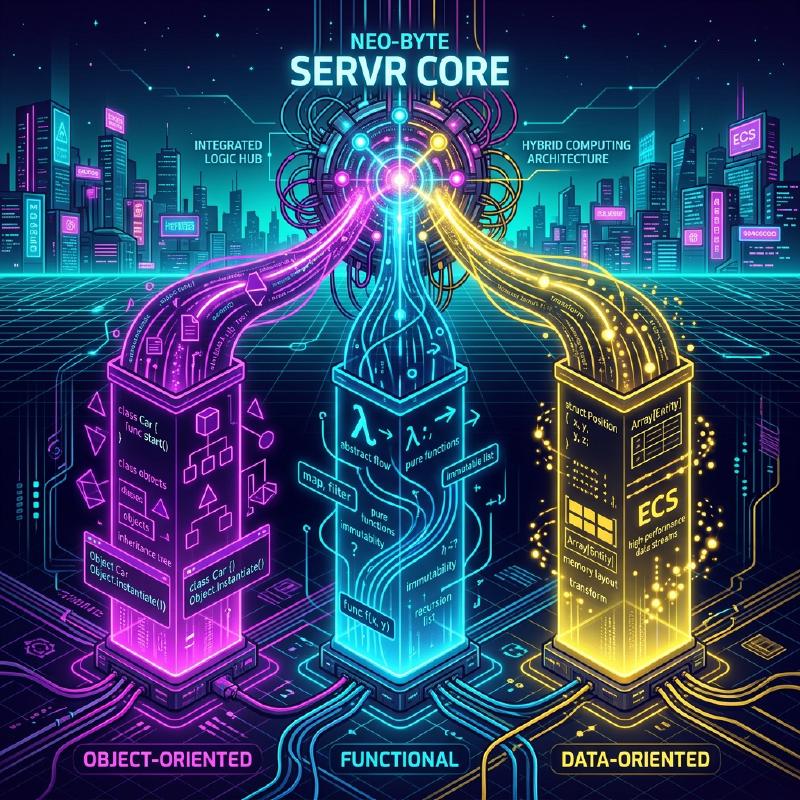
The history of programming language evolution is also a history of battles against complexity. As software grows in scale, developers hit walls related to state management, performance, and maintainability, leading to the proposal of various programming paradigms to overcome them.
In this article, we will take a deep dive into the philosophy, strengths, and limitations of Object-Oriented Programming (OOP), which is mainstream in modern software development, Functional Programming (FP) with its mathematical robustness, and Data-Oriented Programming (DOP / DOD), which focuses on performance and the separation of data. Furthermore, we will explain how powerful modern languages (like Rust and TypeScript) are fusing these paradigms.
1. The Rise and Fall of Object-Oriented Programming (OOP)
Object-Oriented Programming reigned as the absolute king of software development from the 1990s through the 2010s. Languages like Java, C++, and C# drove this paradigm, and its intuitive approach of modeling the real world was widely accepted.
1.1 Core Concepts of OOP
The goal of OOP is to encapsulate “data” and the “behavior” that operates on that data into a single object.
- Encapsulation: Hides internal state and only allows operations through exposed methods.
- Inheritance: Extends existing classes to increase code reusability.
- Polymorphism: Switches between different implementations using the same interface.
| |
1.2 Limitations of OOP and the “Banana and Gorilla Problem”
At first glance, OOP seems like a perfect modeling technique, but as systems scaled, it caused fatal problems such as abuse of inheritance and implicit state management.
There is a famous quote by Joe Armstrong (the creator of Erlang):
“The problem with object-oriented languages is they’ve got all this implicit environment that they carry around with them. You wanted a banana but what you got was a gorilla holding the banana and the entire jungle.”
  classDiagram
    class "GameObject" {
        +Transform transform
        +update()
    }
    class "Character" {
        +Health health
        +move()
    }
    class "Player" {
        +Inventory inventory
        +handleInput()
    }
    class "Enemy" {
        +AIController ai
        +attack()
    }
    "GameObject" <|-- "Character"
    "Character" <|-- "Player"
    "Character" <|-- "Enemy"
Deep inheritance trees complicate code dependencies and make it extremely difficult to extract and reuse specific functionality. Also, when multiple objects reference and modify each other’s states, the predictability of the entire system drops significantly.
2. The Mathematical Approach of Functional Programming (FP)
Functional Programming came into the spotlight as an antithesis to the complexity brought by OOP’s “state mutation”. Not only has it influenced languages like Haskell, Scala, and Clojure, but it also strongly influences modern JavaScript and TypeScript.
2.1 Core Concepts of FP
FP builds programs as combinations of pure functions.
- Pure Functions: Always return the same output for the same input and do not modify external state (no side effects).
- Immutability: Data is not changed once created. If a change is needed, a new data structure is generated.
- Higher-Order Functions and Function Composition: Treats functions as data and combines them to build complex processes.
| |
The transition of state in FP is expressed just like the mathematical function $f(x) = y$. Given a system state $S$ and an action $A$, the new state $S'$ can be expressed as:
$ S' = f(S, A) $
Writing it this way makes testing the code extremely easy and fundamentally eliminates race conditions (data races) in concurrent processing (multi-threading).
2.2 Limitations of FP: Friction with the “Real World”
The functional paradigm also has its limits. Computers are inherently stateful machines (von Neumann architecture), and pure FP deviates from the operating principles of CPUs.
Concepts like memory allocation to maintain immutability (load on garbage collection) and monads to handle “unavoidable side effects” like I/O (screen output, database writes) have a high learning curve and sometimes become performance bottlenecks.
3. Return to Data-Oriented Programming (DOP/DOD)
Data-Oriented Design or Data-Oriented Programming is a paradigm that originated in game development (especially C++ and Rust) and later rippled into the enterprise domain (such as Clojure’s philosophy).
3.1 Core Concepts of DOP
DOP’s supreme mandate is to “separate data and logic”. While OOP combined data and logic into classes, DOP tears them apart.
- Separation of Data: Data is defined merely as data structures (records, structs) without any behavior.
- ECS (Entity Component System): Instead of inheritance, data is split into components, and systems (functions) process them in bulk.
- Cache Efficiency (Memory Layout): Data is placed in contiguous memory (SoA: Structure of Arrays) so it fits into CPU cache lines.
| |
  graph TD
    subgraph "Data (Components)"
        "P"["Positions Array"]
        "V"["Velocities Array"]
        "H"["Healths Array"]
    end

    subgraph "Logic (Systems)"
        "PhysicsSystem"
        "DamageSystem"
    end

    "PhysicsSystem" -->|"Reads"| "V"
    "PhysicsSystem" -->|"Mutates"| "P"
    "DamageSystem" -->|"Mutates"| "H"
3.2 Limitations of DOP: Difficulty in Applying to Business Logic
While DOP (ECS) is invincible in absolute performance domains like game engines, applying it to general Web applications or business logic comes with disadvantages: the code can become too procedural, and data relationships can become scattered (lower cohesion).
4. Comparative Analysis and Trade-offs of Paradigms
Each paradigm has clear strengths and weaknesses.
| Paradigm | Strengths | Weaknesses | Optimal Use Cases |
|---|---|---|---|
| OOP | Intuitive modeling, hiding via encapsulation | Complication of inheritance, bugs from implicit state mutations | GUI frameworks, business domain modeling |
| FP | Resilience to concurrency, ease of testing, predictability | Steep learning curve, performance (GC load) | Data transformation pipelines, concurrent processing systems |
| DOP | Overwhelming performance, transparency of state | Lower data cohesion, tends to be procedural | Game development, high-load computation, embedded systems |
5. The Optimal Solution Today: The “Fusion” of Paradigms
Today, choosing a “single correct answer” among these is considered nonsense. Modern programming languages (Rust, TypeScript, Scala, Go, etc.) take the best parts of these paradigms.
5.1 The Ultimate Fusion Shown by Rust
Rust fuses these three paradigms at an astonishing level.
- Data-Oriented: Memory-efficient data representation using
structandenum. - Functional: Rich Iterator API, pattern matching, and immutability by default.
- Object-Oriented: Polymorphism via
traitand data encapsulation.
| |
This code uses sum types (a functional characteristic) via enum while centrally managing state in a data-oriented manner.
5.2 Practical Architecture in TypeScript
Even in frontend development using TypeScript (like React), the fusion of paradigms has become standard.
- Component UI rendering is Functional (returning UI as pure functions).
- Data fetching and cache management are Data-Oriented (normalized state trees using Redux or Zustand).
- Parts of complex domain logic are Object-Oriented (class-based service layers).
6. Conclusion
Object-Oriented, Functional, and Data-Oriented. These are not mutually exclusive religions.
What’s important is to identify the nature of the domain we are trying to solve. If performance is the top priority, strengthen Data-Oriented elements; if concurrent processing or data transformation flows are central, adopt the Functional approach; and use Object-Oriented techniques for localized domains that require complex business rules and encapsulation.
“Programming paradigms are not about telling us what to do, but rather constraints that tell us what not to do.” — Robert C. Martin
Transcending the walls of paradigms and using multiple weapons depending on context is arguably the most important skill required of next-generation software engineers.