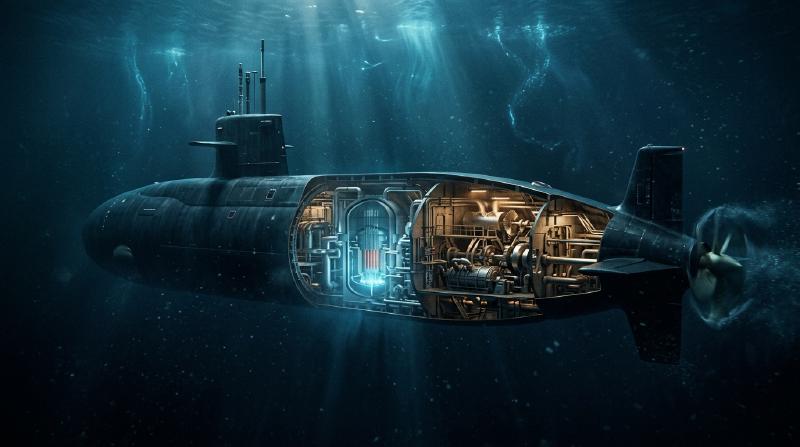
Nuclear Submarine Propulsion Systems and Pressurized Water Reactor Engineering: The Mechanism of Unlimited Power Dominating the Deep Sea
Introduction: System of Systems in Extreme Environments
Nuclear-powered submarines (SSN, SSBN, SSGN) are the most powerful and highly stealthy platforms in modern naval strategy. At their core is the propulsion and power supply system utilizing a shipboard Pressurized Water Reactor (PWR). This article thoroughly dissects the propulsion systems of nuclear submarines—particularly the reactor’s thermal-hydraulic design, neutron kinetics, acoustic engineering, radiation shielding, and even life support systems—from a physical and mathematical perspective, exploring the pinnacle of engineering required under extreme environments.
Chapter 1: The Historical Dilemma of Submarines and the Nuclear Revolution
1.1 Snorkel Navigation and Surfacing Risks of Conventionally Powered Submarines
Up until World War II, submarines were essentially nothing more than “submersibles” (surface ships capable of submerging). Diesel-electric propulsion systems inhaled atmospheric oxygen at the surface or snorkel depth to run diesel engines and charge batteries. When submerged, they drove electric motors using battery power, but this submerged time was limited to anywhere from a few hours to a few dozen hours.
Snorkeling is a fatal vulnerability in modern warfare with advanced radar. The radar cross-section (RCS) of a snorkel mast and the heat signature (infrared signature) of diesel exhaust are easily detected by maritime patrol aircraft (MPA). Unless this fundamental dilemma of “dependence on oxygen” was overcome, a “True Submarine” could not exist. Until the practical application of Air-Independent Propulsion (AIP) systems, periodic surfacing or snorkel deployment was an unavoidable constraint.
1.2 The Madness and Tenacity of Admiral Hyman G. Rickover
It was Admiral Hyman G. Rickover of the US Navy who broke through this technical barrier. Known as the “Father of the Nuclear Navy,” he led an unprecedented project to cram a reactor—an unparalleled energy source—into the narrow hull of a submarine. His perfectionism and an almost “mad” tenacity that permitted absolutely no engineering compromises established the strict safety standards of the Naval Reactors (NR) program.
Rickover deeply understood the inherent dangers of nuclear technology and laid down unprecedentedly strict standards (the foundation of the SUBSAFE program), ranging from crew training to equipment quality control. Shipboard reactors developed under his leadership have never, to this day, suffered a fatal radiation leak accident such as a core meltdown (the losses of the Thresher and Scorpion were not directly caused by reactor runaway).
1.3 The Birth of the World’s First Nuclear Submarine, “USS Nautilus (SSN-571)”
In 1954, the USS Nautilus (SSN-571), the world’s first nuclear-powered submarine, was commissioned. The S2W (Submarine, 2nd generation, Westinghouse) reactor installed on the Nautilus was the very first practical pressurized water reactor (PWR). The historic message from the Nautilus, “Underway on nuclear power,” signified a paradigm shift in naval strategy. The reactor, requiring no atmosphere, granted submarines virtually infinite submerged capability, enabling the operation of strategic nuclear deterrent patrols (SSBN) and fast attack submarines (SSN) accompanying carrier strike groups. The Nautilus accomplished the great feat of crossing under the sea ice of the North Pole (the geographic North Pole), proving that every ocean on Earth was within the operational range of nuclear submarines.
Chapter 2: Design Engineering of Shipboard Pressurized Water Reactors (PWR)
2.1 Refueling-Free Operation for the Ship’s Lifespan with Highly Enriched Uranium (HEU)
While civilian power-generating PWRs use low-enriched uranium (LEU: 3–5% U-235) and require refueling every few years, the latest nuclear submarines of the US and UK use highly enriched uranium (HEU: 20%–93% U-235). US Navy reactors, in particular, use near-weapons-grade 93% HEU to achieve a “Life-of-the-ship core” that requires no refueling for the vessel’s entire lifespan (30 to 40 years).
Refueling requires a massive undertaking involving cutting the hull (Refueling Complex Overhaul, RCOH), leading to years in drydock, enormous costs, and a drop in fleet availability. The adoption of highly enriched uranium is an inevitable consequence of needing to sustain immense power output over a long period within a limited core volume, and to flatten the spatial distribution of the neutron flux. Furthermore, an advanced core design is applied where burnable poisons (such as gadolinium or erbium) are homogeneously mixed into the fuel to suppress the initial excess reactivity and smooth out the reactivity decline associated with fuel burnup over the long term.
2.2 Separation of the Primary Coolant Loop (High-Pressure, High-Temperature Water) and the Secondary Coolant Loop
Shipboard PWRs completely separate the radioactive Primary Coolant Loop from the non-radioactive Secondary Coolant Loop via a Steam Generator (SG).
The primary loop is filled with light water (H2O) that serves both to cool the core and moderate neutrons. To prevent boiling, it is precisely maintained at an extremely high pressure of approximately 15 MPa (about 150 atmospheres) by the pressurizer’s heaters and sprays, and the core exit temperature reaches approximately 300°C to 320°C. This high-temperature, high-pressure light water flows through Inconel U-tubes in the steam generator, heating the secondary coolant water outside the tubes to generate steam. This separation ensures that the Engine Room, housing the turbines and condensers, remains outside the radiation control area, securing a safe working environment for the crew and maintainability for the equipment.
2.3 Neutron Diffusion Equation and Kinetics
The foundation of reactor power control is maintaining a critical state (effective multiplication factor $k_{eff} = 1$). The spatial neutron flux distribution $\phi(\mathbf{r}, t)$ within the core is described by the following neutron diffusion equation (one-group approximation):
$ \frac{1}{v} \frac{\partial \phi}{\partial t} = \nabla \cdot (D \nabla \phi) - \Sigma_a \phi + \nu \Sigma_f \phi + S $
Here, $v$ is the neutron velocity, $D$ is the diffusion coefficient, $\Sigma_a$ is the macroscopic absorption cross-section, $\nu\Sigma_f$ is the neutron production term, and $S$ is the external neutron source. In actual core calculations, multigroup diffusion equations accounting for energy dependence are solved on supercomputers.
Furthermore, the transient time response of the reactor is governed by the Point Reactor Kinetics Equations, taking delayed neutrons into account:
$ \frac{dn(t)}{dt} = \frac{\rho(t) - \beta}{\Lambda} n(t) + \sum_{i=1}^{6} \lambda_i C_i(t) $ $ \frac{dC_i(t)}{dt} = \frac{\beta_i}{\Lambda} n(t) - \lambda_i C_i(t) $
($n(t)$: neutron density, $\rho(t)$: reactivity, $\beta$: delayed neutron fraction, $\Lambda$: prompt neutron lifetime, $C_i$: delayed neutron precursor concentration, $\lambda_i$: decay constant)
In shipboard reactors, safety systems are designed to operate reliably by extremely accurately predicting the response of these delayed neutron groups to reactivity insertions accompanying rapid attitude changes (crash dives, emergency surfacing) or sudden throttle maneuvers during combat.
2.4 Inherent Safety (Negative Reactivity Feedback Coefficient)
In shipboard reactors, physical “Inherent Safety” is extremely important alongside mechanical reactivity control via control rods. This is borne by the Negative Temperature Coefficient of Reactivity:
$\alpha_T = \frac{\partial \rho}{\partial T_m} + \frac{\partial \rho}{\partial T_f} < 0$
- Moderator Temperature Coefficient (MTC): As the core temperature rises, the density of light water decreases (thermal expansion). Since light water is a neutron moderator, the decrease in density leads to insufficient neutron moderation, increasing the probability of resonance absorption by U-238 and thus reducing the core’s reactivity.
- Doppler Coefficient: Due to Doppler Broadening accompanying the temperature rise in the fuel pellets (uranium alloys, etc.), the resonance absorption cross-section of U-238 effectively widens, instantaneously lowering reactivity.
Thanks to this powerful negative feedback mechanism, shipboard reactors can autonomously perform “Load Following” to some extent without manipulating the control rods: when the propulsion turbine throttle is opened and steam demand (thermal load) increases, the temperature of the primary cooling water drops, automatically raising reactivity so the power output catches up.
Chapter 3: Thermal-Hydraulics and Power Conversion Cycle
3.1 Thermodynamics of the Rankine Cycle and the T-s Diagram
Thermodynamically, the propulsion system of a nuclear submarine is a closed Rankine Cycle. The thermal efficiency $\eta_{th}$ of an ideal Rankine cycle is given by the following equation:
$ \eta_{th} = \frac{W_{turbine} - W_{pump}}{Q_{in}} = \frac{(h_1 - h_2) - (h_4 - h_3)}{h_1 - h_4} $
($h_1$: turbine inlet steam enthalpy, $h_2$: turbine outlet, $h_3$: condenser outlet, $h_4$: steam generator inlet)
On a T-s (temperature-entropy) diagram, since shipboard PWRs do not have a high-temperature Superheater like fossil fuel plants, the turbine inlet steam lies on the Saturated Vapor Line. As the moisture content of the steam increases during the expansion process, there is a risk of causing erosion on the turbine blades due to water droplet impact. To prevent this, a Moisture Separator Reheater (MSR) is installed between the high-pressure and low-pressure turbines to improve thermal efficiency and protect the turbines.
3.2 Power Distribution: Propulsion Turbine and Ship’s Service Turbine Generator (SSTG)
The high-pressure saturated steam produced by the steam generator is distributed primarily to the following two components via the main steam lines:
- Main Propulsion Turbine: A massive turbine used to drive the screw propeller or pump-jet. It typically consists of a two-stage configuration of high-pressure and low-pressure turbines, transmitting immense torque to the propulsion shaft via reduction gears.
- Ship’s Service Turbine Generator (SSTG): Generators to supply all the electrical power inside the ship (sonar, fire control systems, environmental control, cooling water pumps, electrolytic oxygen generators, etc.). To ensure redundancy and survivability, usually two or more units operate in parallel.
3.3 Condenser (Direct Cooling by Seawater) and Feed Pump
The low-pressure steam that has expanded and done work in the turbine is led to the Main Condenser. For cooling the condenser, Sea Water passing through fine tubes made of titanium or cupronickel is used. The extremely cold seawater of the deep ocean serves as a superb thermodynamic heat sink, lowering the pressure inside the condenser to a near-vacuum state (low pressure), thereby maximizing the thermal drop (enthalpy difference) across the turbine and improving cycle efficiency.
The condensed water is collected in a Hotwell, pressurized to a high pressure by the condensate pump and Main Feed Pump, and sent back to the steam generator via a feedwater heater.
Chapter 4: Extreme Engineering of Stealth Acoustics
4.1 Physics of Underwater Acoustics and Sonar
For submarines, acoustic stealth (quietness) is an absolute condition for survival. Because electromagnetic waves attenuate rapidly in the ocean, radar cannot be used, and acoustic detection (passive and active sonar) becomes the only long-range detection method. The Transmission Loss Equation describing underwater acoustic propagation is expressed as follows:
$ TL = 20 \log_{10} r + \alpha r + A $
Here, $r$ is the distance, $\alpha$ is the absorption attenuation coefficient of seawater (frequency-dependent), and $A$ is the anomalous attenuation due to scattering and refraction at the sea surface/seabed. To minimize the detection range, the submarine’s Source Level (SL) of radiated noise must be reduced to the absolute limit.
4.2 Eliminating Reduction Gear Mesh Noise and Cavitation
While steam turbines rotate at high speeds of thousands of rpm for thermal efficiency, the screw propeller must be rotated at low speeds of a few hundred rpm or less to prevent cavitation (the generation and collapse of bubbles caused when local pressure in the water drops below the saturated vapor pressure). Therefore, a Main Reduction Gear (MRG) is indispensable.
The Gear Mesh Tonal noise of massive gears has specific frequency peaks (tone noise), which can be easily identified and classified by the enemy’s passive sonar narrowband analysis (such as LOFAR grams). To prevent this, the cutting precision of the gears is controlled to the micron level, and the adoption of helical gears and special vibration-absorbing shaft couplings (flexible couplings) are utilized.
4.3 Raft Structure (Floating Deck and Double-Resilient Rubber Mounts)
To prevent the mechanical noise of the engine room from traveling through the hull (structure-borne noise) and radiating into the ocean, a floating deck known as “Rafting” is adopted. The main vibration sources, such as turbines, generators, and gearboxes, are placed on a massive common base (raft), and the raft itself is supported against the Pressure Hull by numerous massive Shock and Vibration Mounts, forming a double-resilient structure. By doing so, vibrational energy is attenuated multiple times, and acoustic radiation to the outside is drastically blocked.
4.4 Quiet Cruising via Natural Circulation Reactor
One of the largest noise sources in a nuclear submarine is the Primary Coolant Pump (PCP) used to force the circulation of the primary cooling water. State-of-the-art vessels like the Ohio class (SSBN) and Virginia class (SSN) feature a core design that maximizes the use of “Natural Circulation.”
By placing the core in the lower part of the hull and the steam generator in the upper part, it creates a massive thermal convection (thermosiphon effect) where the water heated and lightened in the core rises, and the water cooled and made heavier in the steam generator descends. This allows the reactor to maintain cooling and power output at low to medium cruising speeds (tactical patrol speeds) while keeping the noise-causing cooling water pumps completely turned off. A nuclear submarine with its pump noise eliminated truly becomes an “oceanic black hole.”
4.5 Waterjet Propulsion (Pump-Jet)
To suppress the occurrence of cavitation and Tip Vortex caused by propellers, many nuclear submarines from the British Trafalgar class and the US Seawolf class onwards have adopted Pump-Jet Propulsors. This consists of numerous moving blades (rotors) and stationary blades (stators) covered by a duct (shroud), increasing the local static pressure by decelerating and pressurizing the water flow inside the duct. This is a highly advanced hydrodynamic design that significantly raises the Cavitation Inception Speed and suppresses the radiation of broadband noise.
Chapter 5: Radiation Shielding and Life Support Systems
5.1 Multi-Layered Defense of Primary and Secondary Shielding
To shield against the intense neutron and gamma rays generated from the reactor, heavy multi-layered shielding is applied to the Reactor Compartment.
- Primary Shielding: The shielding that directly surrounds the reactor pressure vessel. Composed primarily of thick steel and water (the primary cooling water and dedicated shield water tanks), it moderates and absorbs fast neutrons from the core and strongly attenuates primary gamma rays.
- Secondary Shielding: The bulkheads covering the entire reactor compartment. Composite materials of polyethylene (which is rich in hydrogen atoms and effectively moderates neutrons) and lead (which has high density and blocks gamma rays) are used.
Through these exhaustive shielding designs, the annual radiation exposure received by the crew in the engine room and living quarters is strictly controlled to levels lower than the natural background radiation received by ordinary people living on land.
5.2 The Ultimate Closed System: Main Electrolyzer Assembly (MEA)
The interior of a nuclear submarine that carries out missions for months without surfacing is an ultimate closed environment akin to a space station. To sustain the lives of the crew (approximately 130 people), highly advanced environmental control systems powered by the abundant electricity from the reactor are in operation.
Oxygen is generated by the Electrolysis of pure water obtained by desalinating seawater. The Main Electrolyzer Assembly (MEA) consumes massive amounts of power, but it can produce oxygen inexhaustibly as long as there is seawater. Cathode: $ 4H_2O + 4e^- \rightarrow 2H_2 + 4OH^- $ Anode: $ 4OH^- \rightarrow O_2 + 2H_2O + 4e^- $
5.3 Carbon Dioxide Scrubber (Amine Scrubber) and Carbon Monoxide Burner
The carbon dioxide (CO2) exhaled by the crew is chemically adsorbed and removed by an amine scrubber (a CO2 absorption device using a monoethanolamine solution). The amine solution that absorbs CO2 at low temperatures is regenerated by being heated using steam from the reactor to release the CO2. The separated highly concentrated CO2 is pressurized by a compressor and secretly discharged into the ocean. Furthermore, trace amounts of carbon monoxide (CO) and hydrogen (H2) generated from cooking and equipment are oxidized into safe water and carbon dioxide by a catalytic CO/H2 Burner.
5.4 Seawater Desalination Plant
Tens of thousands of liters of fresh water per day are required for drinking, cooking, showering, and as makeup water for the reactor and batteries. This is continuously produced from seawater by Multi-Stage Flash Distillation plants utilizing the exhaust heat and steam of the reactor, or by the latest Reverse Osmosis (RO) plants.
Chapter 6: The Genealogy of Nuclear Submarines and Future Propulsion Technologies
6.1 The Genealogy of the US Navy: Los Angeles Class, Seawolf Class, Virginia Class
The attack submarines of the US Navy have evolved while countering the threat of Soviet submarines during the Cold War.
- Los Angeles Class (SSN-688): Equipped with the S6G reactor. Boasts high speed (over 30 knots), but early models had issues with quietness. Later models (Flight III) saw significant improvements in silence and added Vertical Launch Systems (VLS).
- Seawolf Class (SSN-21): Equipped with the S6W reactor. The ultimate nuclear submarine designed at the end of the Cold War solely to “hunt Soviet nuclear submarines in the deep sea.” It is extremely quiet, featuring a pump-jet and natural circulation capabilities, but construction costs skyrocketed, and production was halted at three ships.
- Virginia Class (SSN-774): Equipped with the S9G reactor. A multi-purpose nuclear submarine optimized for Littoral Warfare and the deployment of special forces while maintaining the quietness of the Seawolf class. Characterized by modern avionics such as modular design, fiber optic masts, and fly-by-wire steering systems.
6.2 The Genealogy of the Russian Navy: Akula Class, Borei Class
The Soviet/Russian Navy has also undergone its own evolution. While there were once unique high-speed ships like the Alfa class that adopted liquid-metal-cooled reactors (lead-bismuth alloy), PWRs are currently the mainstream.
- Akula Class (Project 971): Equipped with the OK-650B/b reactor. A 3rd-generation attack submarine with extremely high quietness that shocked the US Navy, and it remains the mainstay of the Russian Navy today.
- Borei Class (Project 955): The state-of-the-art strategic missile submarine (SSBN) equipped with the OK-650V reactor. It adopted Russia’s first pump-jet propulsion, dramatically enhancing acoustic stealth, making it a threat on par with the US Navy’s Ohio class.
6.3 Integrated Full Electric Propulsion (IFEP) and Permanent Magnet Motors (PMM)
In the next generation of nuclear submarines (such as the US’s upcoming SSN(X) attack submarines and the UK’s Columbia/Dreadnought class), a fundamental transformation of the propulsion system is occurring. It is the transition from the traditional mechanical direct-drive method of “reactor → steam turbine → reduction gear → propeller shaft” to Integrated Full Electric Propulsion (IFEP), which flows as “reactor → turbine generator → high-power cable → electric motor → propeller.”
High-torque, high-efficiency Permanent Magnet Motors (PMM) are adopted for the propulsion motors. The introduction of IFEP brings immense benefits such as:
- Gearless Propulsion: The massive “main reduction gear,” a major noise source, can be completely eliminated, improving quietness beyond dimensions.
- Layout Flexibility: The long penetrations for the propeller shaft and placement constraints of turbines are eliminated, drastically improving the layout flexibility of the reactor compartment and propulsors.
- Power Flexibility: The massive power used for propulsion can be instantaneously redirected to future Directed Energy Weapons (lasers), high-power active sonar, and charging numerous Unmanned Underwater Vehicles (UUVs).
6.4 Spillover to Small Modular Reactor (SMR) Technologies
The design philosophy of shipboard PWRs—“extremely compact,” “long life with no refueling,” “high passive safety through natural circulation,” and “high load-following capability”—is exactly the design concept of civilian Small Modular Reactors (SMRs), which are currently being researched and developed worldwide as a countermeasure against climate change. The thermal-hydraulic engineering and operational track records cultivated by nuclear submarines over more than half a century under the harsh environments of the deep sea are bathing in a new light as a crucial technological foundation for the next-generation nuclear energy systems supporting a decarbonized society.
Supplement: Mathematical Details Governing Extreme Engineering (Special Appendix)
Here, we will delve deeper into the specialized equations and theoretical backgrounds that approach the true essence of nuclear submarines, even if it requires spending word count to describe.
1. Two-Phase Flow Thermal Hydraulics and DNB (Departure from Nucleate Boiling)
In the core of a pressurized water reactor, bulk boiling of the cooling water is not permitted during normal operation. However, Subcooled Boiling occurs in microscopic regions on the surface of the fuel rods, and this dramatically increases the heat transfer coefficient. If the local heat flux exceeds a Critical Heat Flux (CHF), it transitions to “film boiling,” where the fuel rod surface is covered by a continuous vapor film, leading to a rapid deterioration in heat transfer and the danger of fuel cladding melting. This phenomenon is called DNB (Departure from Nucleate Boiling). In the thermal design of shipboard reactors, maintaining the DNB Ratio (DNBR) strictly above a safe margin is the supreme mandate. To accurately calculate the heat flux distribution and enthalpy rise within the fuel assemblies, which have complex flow channel shapes, highly advanced coupled simulations of CFD (Computational Fluid Dynamics) and neutron transport calculations are applied in the design of modern shipboard reactors.
2. Structural Mechanics of Yielding and Buckling in the Pressure Hull
While different from the propulsion system, the engineering of the Pressure Hull, which determines the submarine’s Test Depth, is also important. At a depth of 400m, approximately 400 tons of pressure is applied per square meter. The failure modes of a pressure hull include “Yielding” of the material and “Elastic Buckling.” The critical buckling pressure $P_c$ for a perfectly circular cylindrical shell is evaluated by complex formulas taking into account the reinforcement effects of frames (ribs). The state-of-the-art submarines of the US Navy use high-tensile steels like HY-80 and HY-100 (yield strength 100,000 psi = approx. 690 MPa), while lightweight, high-strength titanium alloys have been adopted in some ships of the Russian Navy.
3. Rayleigh-Plesset Equation of Cavitation
The dynamic behavior of cavitation bubbles on a propeller is described by the Rayleigh-Plesset Equation: $ R \frac{d^2R}{dt^2} + \frac{3}{2} \left( \frac{dR}{dt} \right)^2 = \frac{1}{\rho_L} \left( p_B(t) - p_{\infty}(t) - \frac{2S}{R} - \frac{4\mu}{R} \frac{dR}{dt} \right) $ ($R$: bubble radius, $\rho_L$: liquid density, $p_B$: pressure inside bubble, $p_{\infty}$: pressure at infinity, $S$: surface tension, $\mu$: viscosity coefficient) The intense microjets and shock waves generated when the bubbles collapse are the greatest enemies that invite acoustic detection.
Conclusion
Nuclear submarines are the most complex and refined crystallization of engineering humanity has ever built. The process of converting the immense energy generated by the nuclear fission chain reaction of a pressurized water reactor into underwater thrust and electrical power with extreme quietness brings together the best of fluid dynamics, thermodynamics, neutron physics, and acoustic engineering. Even now, nearly 70 years after the Nautilus’s first dive, the technological pursuit to dominate the deep sea knows no bounds. Having acquired unlimited power, these steel leviathans will continue to quietly and powerfully fulfill their missions in the abyss of the ocean.
Further Deep Dive: Strategic Significance and Technical Constraints in Nuclear Submarine Operations
As detailed in the preceding chapters, the systems of a nuclear submarine are the crystallization of advanced theoretical physics, thermal engineering, and materials engineering. However, these extreme engineering feats are not merely technical self-satisfaction, but inevitable necessities calculated backwards from the highly severe operational requirements in modern maritime strategy. This section considers how these technical elements directly tie into strategic operations from a broader perspective.
1. The Strategic Paradigm Shift Brought by “Unlimited Power”
Diesel-electric conventionally powered submarines, with their superb quietness, demonstrate unmatched strength in “ambushes” and “coastal defense.” In particular, the latest conventionally powered submarines equipped with lithium-ion batteries or Air-Independent Propulsion (AIP) systems enable submerged operations for weeks on end, and in the short term, they can sometimes possess stealthiness that surpasses even nuclear submarines. However, the capability possessed by nuclear submarines to “advance to the other side of the globe at high speeds of over 20 knots without surfacing for months” is a strategic privilege that conventionally powered submarines can absolutely never emulate.
When escorting a Carrier Strike Group (CSG), the aircraft carrier travels at high speeds close to 30 knots. In order to accompany it and clear the path ahead, a submarine must also be able to sustain high speeds for a prolonged period. If a conventionally powered submarine runs at high speed, its batteries will be depleted in a few hours, forcing it to undertake fatal snorkel navigation. In other words, only nuclear submarines satisfy the requirements of a true “Blue-water navy.”
2. Operational Capability in Polar Regions and Under Ice
As the Nautilus proved, nuclear submarines are the only weapons capable of freely navigating under the ice of the Arctic Ocean (Under-ice operations). Because they do not need to surface to replenish air, they can operate even under multi-year ice that is several meters to dozens of meters thick. For ballistic missile submarines (SSBN), the Arctic Ocean is the best “Bastion” (sanctuary). The thick ice completely blocks sonobuoys dropped from maritime patrol aircraft and sonar detection from surface ships. Furthermore, the irregular underside of the sea ice causes sound waves to scatter erratically, making tracking by enemy attack submarines (SSN) extremely difficult. This under-ice operational capability is the most reliable guarantee of nuclear deterrence from the Cold War era to the present day.
3. The Complexity of Deep-Sea Acoustic Environments and Tactical Superiority
Acoustic detection by sonar is not simply a function of distance. The speed of sound changes depending on the seawater’s temperature, salinity, and water pressure (depth), forming a complex distribution known as the “Sound Speed Profile” relative to depth. This creates unique acoustic environments in the ocean, such as a “Surface Duct,” a “SOFAR Channel” (Deep Sound Channel) where sound travels exceptionally far, or a “Shadow Zone” where sound does not reach at all.
Sonar Technicians and tactical officers of nuclear submarines are intimately familiar with this ocean physics, deploying advanced three-dimensional maneuver warfare such as hiding their own ship in a shadow zone while detecting enemy ships in the Convergence Zone of a sound channel. At this time, it is the unlimited power of the shipboard reactor and the robust pressure hull constructed of titanium alloys or high-tensile steel that enables rapid changes in submerged depth.
4. Hydrodynamic Trade-offs During High-Speed Navigation
When a nuclear submarine travels at high speed, hydrodynamic trade-offs occur. A hull cleaving through the seawater at high speed generates friction and separation noise called “Flow Noise.” Even more serious is the turbulence of the water flow around the sonar dome. The massive spherical sonar (or bow sonar) mounted on the bow suffers a significant drop in detection capability due to the intense noise (self-noise) generated by the turbulence around the hull while the ship is moving at high speed (this is called “sonar self-blinding”). Therefore, “high-speed transit to the theater” and “quiet searching” are always in a trade-off relationship. To solve this, a Towed Array Sonar is used. By towing a cable-like sonar array that is hundreds of meters to several kilometers long behind the ship, putting physical distance between it and the propulsor noise and hull flow noise, it becomes possible to capture faint acoustic signatures from the rear and at long distances even during high-speed navigation.
5. Radiation Protection and the Psychological/Physiological Limits of the Crew
In modern nuclear submarines, where technical constraints have been largely overcome, the most critical limiting factor is the “human crew.” Even with unlimited power, patrol periods are typically limited to about 60 to 90 days due to the carrying capacity for food and the psychological stress limits of the crew. Long-term missions in a closed space disrupt the crew’s circadian rhythm. Because no external light reaches them, the lighting inside the ship switches between light and dark on an 18-hour cycle (the traditional US Navy shift) or a 24-hour cycle, artificially creating day and night. Additionally, long-term exposure to minute amounts of radiation or trace chemicals from equipment (such as fine oil mist or gas derived from amine scrubbers) is managed through exhaustive air purification systems and monitoring. Ultimately, however, as long as flesh-and-blood humans continue to operate these steel machines, true “unlimitedness” will not arrive until the era of Unmanned Underwater Vehicles (UUVs).