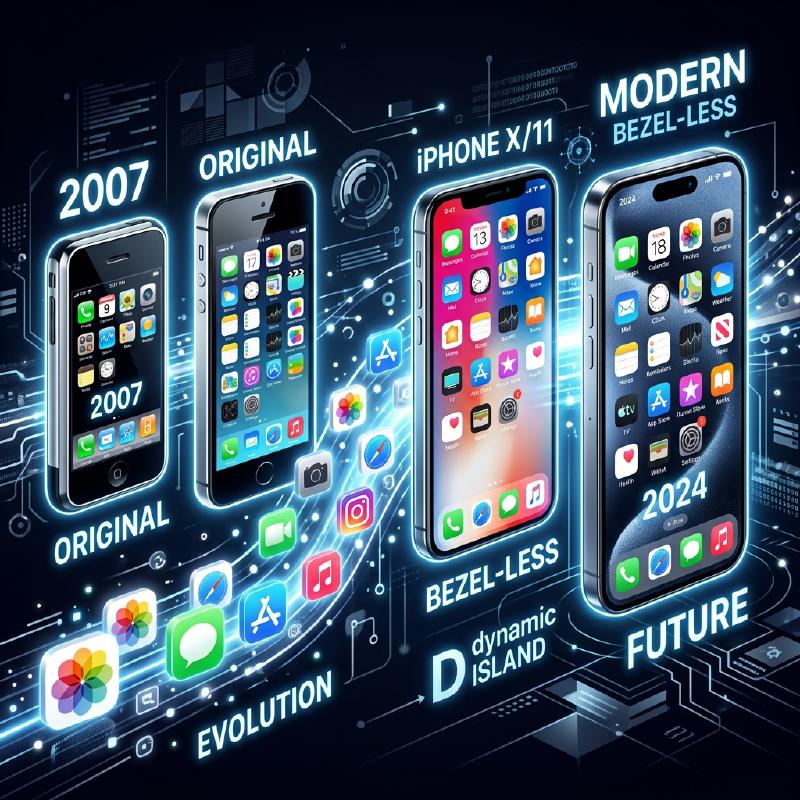
1. 2007: “Today, Apple is going to reinvent the phone”
On January 9, 2007, on the stage of the Macworld Expo, Steve Jobs delivered a legendary presentation that would go down in technology history. He said, “Today, we are announcing three revolutionary products: a touch-controlled iPod, a revolutionary mobile phone, and a breakthrough internet communications device,” revealing that these were not three separate devices, but just one device: the iPhone.
At that time, cell phones (such as BlackBerry) had half of their bodies occupied by small physical keyboards. The iPhone eliminated all those keyboards, adopting a design that was considered insane at the time, turning almost the entire front face into a “multi-touch capable glass screen.” A “screen that changes freely through software” was the true beginning of the mobile revolution.
2. The Original iPhone and the Birth of the “App Store” (2007-2008)
The original iPhone was released only in the US, but it sent shockwaves around the world. However, the iPhone at that time lacked features that are taken for granted today. It did not support 3G communication (only 2G), had no copy-and-paste functionality, and most importantly, it had a specification where “third-party apps could not be installed.”
The true revolution occurred the following year, in 2008, with the introduction of the App Store, announced alongside the “iPhone 3G.” This platform, which allowed developers to freely create apps and sell them directly to users worldwide, established the concept of the “smartphone = a palm-sized computer that can add infinite features.” Numerous massive businesses, such as Angry Birds and Instagram, would be born from the App Store.
3. The Impact of Retina Display and Siri (2010-2011)
The iPhone 4, announced in 2010, revamped its design into a flat shape made of glass and stainless steel, and featured a high-definition Retina Display that exceeded the limits of the human retina. The shock of seeing on-screen text as clearly as printed matter raised the standard for all subsequent smartphones.
In the following year’s iPhone 4S (2011), the voice assistant Siri was featured for the first time. It showed the future of “talking to operate” a smartphone, but the day after this announcement, Steve Jobs passed away. The iPhone 4S became the last iPhone that Jobs saw through to completion.
4. Larger Screens and the Evolution of Biometric Authentication (2012-2017)
After Jobs’s passing, Apple under Tim Cook’s leadership gradually expanded the screen size of the iPhone in response to user requests.
- iPhone 5 (2012): Elongated vertically from 3.5 inches to 4 inches, and supported high-speed LTE communication. It adopted the Lightning connector for the first time.
- iPhone 5s (2013): Featured the Touch ID fingerprint authentication system on the home button. It eliminated the hassle of entering passwords and dramatically improved security.
- iPhone 6 / 6 Plus (2014): Further enlarged to 4.7 inches and 5.5 inches. Competing against large Android smartphones, it recorded explosive hits worldwide.
5. The Disappearance of the Home Button and the Impact of the iPhone X (2017)
In 2017, the 10th anniversary of the iPhone’s birth, Apple announced the iPhone X (Ten), which once again redefined the shape of the smartphone.
It finally abolished the iconic home button, adopting a bezel-less design that covered the entire front face with an OLED display. Instead of Touch ID, it featured Face ID, which recognizes faces in 3D, and the new gesture control of swiping up from the bottom of the screen to return home became the de facto industry standard for all subsequent smartphones.
6. The Evolution of Cameras and the Current iPhone (2019-Present)
From the iPhone 11 Pro (2019) onwards, the main battleground of the iPhone’s evolution shifted to “cameras and computational photography.” Equipped with three lenses—ultra-wide, wide, and telephoto—and using the overwhelming AI processing power of Apple Silicon (A-series chips), it achieved cinematic visual expression in the palm of your hand, rivaling professional video cameras. This included Night mode for bright shots even in the dark and Cinematic mode for cinematic bokeh effects.
7. Conclusion
On that day in 2007, the iPhone, which debuted as a strange phone without a keyboard, fundamentally changed our communication, work, entertainment, and the very nature of society itself.
Even though it is said every year that “there is no more room for evolution,” the iPhone continues to run at the forefront of technology through material revamps, chip performance improvements, and the integration of AI (Apple Intelligence). When will be the next time they reinvent what is in our pockets?