Corporate History: The Story of Intel - Birth of the Microprocessor and Sovereign of Silicon Valley
In contemporary society, computers have become as essential to human survival as running water or electricity. And for more than half a century, the evolution of the “brain” powering this digital reality has been spearheaded by Silicon Valley’s titan: Intel Corporation. From the democratization of personal computing to the explosive rise of the internet, enterprise cloud infrastructure, and generative AI, Intel’s corporate history is inextricably woven into the fabric of the modern technological revolution.
This article provides an exhaustive, multi-faceted retrospective of Intel’s epic journey—from its founding in Mountain View and the invention of the commercial microprocessor to dramatic strategic pivots, intense competitive wars, and its ambitious IDM 2.0 resurgence.
1. The Dawn of Silicon Valley and the Birth of Intel (1968)
Intel’s saga begins in 1968 in Mountain View, California. Robert Noyce (co-inventor of the integrated circuit) and Gordon Moore (a brilliant physical chemist), both foundational pioneers at Fairchild Semiconductor, grew frustrated with corporate bureaucracy and decided to strike out on their own.
Backed by legendary venture capitalist Arthur Rock, they secured funding with a business plan barely exceeding a few typed pages. They named their startup “Intel”—a portmanteau of “Integrated Electronics.” Shortly after founding, they were joined by Andy Grove, a chemical engineer who would become the operational engine and heart of the company. Together, Noyce (the visionary diplomat and external face), Moore (the technical genius), and Grove (the relentless, iron-willed executioner) formed the most formidable management triumvirate in Silicon Valley history.
Intel’s initial corporate objective was straightforward yet audacious: replacing magnetic core memory with high-speed, compact semiconductor memory. Their intuition proved prophetic. In 1970, Intel launched the “1103”—the world’s first commercially viable Dynamic Random-Access Memory (DRAM) chip. The 1103 became an international blockbuster, displacing core memory and immediately crowning Intel as the world’s reigning memory chip manufacturer.
2. Inventing the Microprocessor: A Serendipitous Breakthrough (1971)
The most transformative turning point in Intel’s history—and arguably in the history of human technology—arrived in 1971. A Japanese calculator manufacturer called Busicom approached Intel with a specification to design twelve custom Large-Scale Integration (LSI) chips for its new line of electronic printing calculators.
Intel was still a lean enterprise, lacking the engineering bandwidth to design twelve bespoke application-specific chips simultaneously. Intel engineer Marcian “Ted” Hoff, alongside Federico Faggin, Stan Mazor, and Busicom engineer Masatoshi Shima, proposed an entirely radical counter-architecture:
Instead of designing rigid, specialized hardware circuits for every discrete task, why not design a single, general-purpose silicon processing engine whose function could be infinitely reprogrammed via software?
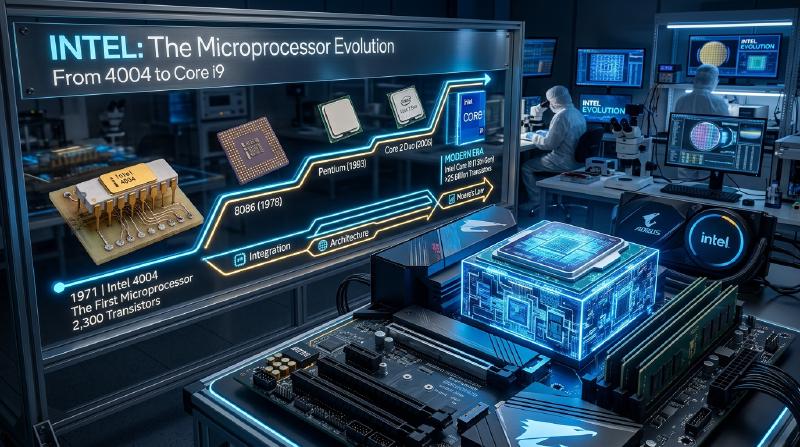
This breakthrough catalyzed the birth of the world’s first commercial single-chip microprocessor: the Intel 4004 in November 1971. Integrating roughly 2,300 microscopic transistors onto a fingernail-sized piece of silicon, this 4-bit chip commanded computational prowess rivaling room-sized mainframe computers from the previous decade.
  flowchart LR
    Intel4004["Intel 4004 (1971)"] --> Intel8008["Intel 8008 (1972)"]
    Intel8008 --> Intel8080["Intel 8080 (1974)"]
    Intel8080 --> x86["x86 Architecture (1978)"]
    x86 --> Pentium["Pentium (1993)"]
    Pentium --> Core["Core i Series (2006-)"]
Intel swiftly expanded into 8-bit computing with the 8008 (1972) and the seminal 8080 (1974). The Intel 8080 became the foundational brain of the Altair 8800—widely recognized as the spark that ignited the personal computer revolution, prompting Bill Gates and Paul Allen to establish Microsoft and inspiring Steve Jobs and Steve Wozniak to assemble the Apple I.
3. Moore’s Law and Driving Semiconductor Cadence
Any serious discussion of Intel is inseparable from Moore’s Law. Articulated as an empirical observation by Gordon Moore in 1965, it posited that the number of transistors packed onto a dense integrated circuit would double approximately every 18 to 24 months, exponentially increasing performance while halving cost per transistor.
$$ P = 2^{ rac{t}{1.5}} $$(where $P$ represents relative transistor density and $t$ represents elapsed time in years)
Moore’s Law transcended mere observation; it functioned as a self-fulfilling prophecy and the sacred drumbeat of the entire electronics industry. To maintain this unforgiving cadence, Intel poured billions of dollars into advanced R&D and cutting-edge fabrication facilities (“fabs”), operating as the undisputed pacemaker of global computing progress.
4. The Agonizing Pivot: Abandoning Memory for Microprocessors (1980s)
By the mid-1980s, Intel faced an existential apocalypse. A wave of Japanese conglomerates (including NEC, Toshiba, and Hitachi) flooded the global DRAM market with superior manufacturing yields, flawless reliability, and ultra-aggressive pricing. Intel’s core founding business—its memory division—hemorrhaged catastrophic losses.
Amid this crisis, a legendary boardroom conversation took place between CEO Gordon Moore and President Andy Grove:
Grove: “If we got kicked out and the board brought in a brand-new CEO, what would he do?”
Moore: “He would get us out of memories.”
Grove: “Why shouldn’t you and I walk out that door, come back in, and do it ourselves?”
In 1985, Intel executed one of the most celebrated corporate pivots in business history: shutting down its foundational DRAM operations and betting the entire survival of the company on microprocessors.
Fortunately, Intel held an ace. In 1981, IBM had chosen Intel’s 16-bit “8088” microprocessor as the central computational engine for the original IBM PC. As IBM-compatible clone PCs exploded globally, Intel’s “x86” instruction set architecture became the de facto standard of personal computing. Through an aggressive corporate campaign dubbed “Operation CRUSH,” Intel vanquished rival architectures from Motorola and Zilog, solidifying its monopoly over PC computing.
5. The Wintel Era and the “Intel Inside” Cultural Phenomenon (1990s)
The 1990s represented Intel’s golden age of absolute dominance. The duopoly formed between Microsoft’s Windows operating system and Intel’s x86 microprocessors—universally known as the “Wintel” alliance—dictated the global computing landscape. Successive processor generations (the 386 and 486) established hardware performance as the primary driver of multimedia and the burgeoning World Wide Web.
In 1993, Intel introduced the “Pentium” processor. Departing from numerical designations (like 586) which US courts had ruled un-trademarkable, the Pentium quickly became a household name synonymous with cutting-edge speed.
This brand equity was turbocharged by the legendary “Intel Inside” marketing campaign launched in 1991. By co-funding PC makers’ print and television advertisements on the condition that they display the swirling Intel swirl logo and the iconic five-note chimes, Intel transformed an invisible, internal silicon component into the ultimate seal of computing quality. This granted Intel unprecedented pricing power over global PC manufacturers.
Andy Grove, who served as CEO during this triumphant era, codified the company’s hyper-competitive operational culture in his best-selling management manifesto, Only the Paranoid Survive.
6. The Multi-Core Revolution and the Brutal War with AMD (2000s)
In the early 2000s, Intel fell victim to technological hubris. Its “NetBurst” microarchitecture (powering the Pentium 4) sought raw clock speeds exceeding 4 GHz, but slammed directly into an unforgiving thermodynamic barrier: the physical “Power Wall.” Excessive leakage currents and extreme heat dissipation threatened to melt silicon dies.
Seizing this critical misstep, longtime rival AMD struck hard with its Athlon 64 and Opteron processors. AMD beat Intel to the punch by introducing the 64-bit x86-64 instruction set and an integrated on-die memory controller, capturing massive market share in desktops and enterprise server rooms.
Intel averted disaster through a brilliant engineering counter-offensive spearheaded by its design team in Haifa, Israel. Abandoning the NetBurst dead end, Intel pivoted to energy-efficient “Multi-Core” parallelism and high Instructions Per Cycle (IPC). The resulting “Core” microarchitecture, launched in 2006 as the “Core 2 Duo,” annihilated AMD’s architectural lead, restoring Intel’s crown.
To maintain execution discipline, Intel instituted its famous “Tick-Tock” cadence: alternating every year between shrinking the manufacturing process node (a “Tick”) and rolling out a completely new microarchitecture (a “Tock”). This clockwork rhythm dominated the industry for a decade.
7. Missing the Mobile Revolution and Fabrication Stagnation (2010s)
Despite its desktop and server dominance, the 2010s brought Intel’s greatest strategic failure: completely missing the smartphone revolution. When Steve Jobs approached Intel to manufacture the application processor for the original iPhone, Intel’s leadership declined, believing projected production volumes could never justify the design costs. Consequently, the mobile paradigm exploded around ARM-based architectures manufactured by rivals like Qualcomm and Apple, leaving Intel completely sidelined in mobile devices.
Worse, Intel’s foundational crown jewel—its undisputed leadership in semiconductor manufacturing—crumbled. Severe, multi-year engineering delays in bringing its 14nm and 10nm process nodes to volume production derailed Moore’s Law.
Sensing vulnerability, a resurgent AMD under Dr. Lisa Su unleashed its Zen (Ryzen/EPYC) architecture, dismantling Intel’s performance monopoly. Simultaneously, Taiwan’s pure-play foundry giant, TSMC, mastered Extreme Ultraviolet (EUV) lithography, officially surpassing Intel in microchip fabrication density. Intel’s traditional Integrated Device Manufacturer (IDM) model—designing and building its own silicon exclusively in-house—appeared dangerously outmoded.
8. The Resurgence: IDM 2.0, Foundry Ambitions, and the AI Frontier (2020s–Present)
In early 2021, amidst organizational fatigue and lost technological leadership, Intel welcomed back Pat Gelsinger—an accomplished engineer who had served as Intel’s first Chief Technology Officer during its golden era—as CEO. Gelsinger launched a bold, high-stakes turnaround strategy: IDM 2.0.
The IDM 2.0 strategy rests on three interconnected pillars:
- Regaining Process Leadership: Executing the unprecedented roadmap of delivering “5 nodes in 4 years” (culminating in the Intel 18A node with RibbonFET gate-all-around transistors and PowerVia backside power delivery).
- Intel Foundry: Opening state-of-the-art fabs to external fabless customers, backed by massive mega-fab investments across Ohio, Arizona, Germany, and Ireland to rival TSMC.
- Strategic Use of External Foundries: Utilizing leading-edge external nodes where economically prudent.
In the enterprise computing arena, the generative AI boom ignited fierce demand for AI accelerators, an arena dominated by NVIDIA’s GPUs. Intel has aggressively mobilized its “Gaudi” series of deep learning accelerators and launched the “Core Ultra” processor series to pioneer the “AI PC” era, shifting on-device neural processing to local hardware.
Furthermore, backed by the US CHIPS and Science Act and European subsidies aimed at reshoring semiconductor supply chains, Intel has evolved into a strategically indispensable asset for Western economic and national security.
Conclusion: The Silicon Giant That Built the Modern World
Intel’s history is an epic saga of perseverance against the laws of physics and market shifts. Multiple times over the past six decades, Intel stood on the precipice of ruin—from the collapse of DRAM in the 1980s to the Power Wall in 2005 and manufacturing delays in 2020. Yet each time, it summoned painful restructuring and engineering genius to reinvent itself.
From a modest startup in Mountain View that etched 2,300 transistors onto the 4004 to a geopolitical titan orchestrating sub-nanometer super-structures, Intel’s legacy is the digital world itself. As it navigates the high-stakes battles of the IDM 2.0 era and generative AI, the giant of Silicon Valley continues to define the frontier of human computational power.