1. Pivot from an OS for Cameras
Currently, “Android”, a massive OS that holds about 70% of the global smartphone market share, started not with Google but with a small startup company called “Android Inc.”. Founded in 2003 by Andy Rubin and others, Android Inc. was initially developing an advanced operating system for digital cameras. However, sensing the limits to growth in the digital camera market, they shifted their target to “mobile phones (feature phones)”.
Google acquired the financially struggling company in 2005 for a mere $50 million. At the time, the iPhone was not even a rumor, and Google’s aim was to “secure a platform for future mobile search”.
2. 2007, the Appearance of the iPhone and Starting with a Blank Slate
In January 2007, Steve Jobs announced the first iPhone. The prototype “Sooner” being developed by the Android team at the time was an old design with a physical keyboard like a BlackBerry. Seeing the iPhone’s innovative multi-touch screen, it is said that Andy Rubin, listening to the presentation in his car, realized, “What we were making was garbage. We have to start over.”
They completely scrapped their development and drastically changed course to develop a new OS called “Dream,” optimized for touch screens.
3. Formation of the Open Handset Alliance (OHA)
The strategy Google took was exactly the opposite of Apple’s vertical integration model of “monopolizing hardware and software in-house”. In November 2007, Google announced the formation of the “Open Handset Alliance (OHA),” involving mobile device manufacturers like Samsung, HTC, and Motorola, semiconductor makers like Qualcomm, and telecommunications carriers.
Google offered the developed Android OS completely free of charge (open source), allowing manufacturers to freely customize and install it on their own smartphones. For manufacturers, it was a compelling proposal with no reason to refuse: they no longer needed to spend massive development costs creating their own OS, and Google’s powerful services (Search, Maps, YouTube) were available right out of the box.
4. The First Android Device “HTC Dream” and the Secret of Version Names
In October 2008, the world’s first Android-powered smartphone, the “HTC Dream (T-Mobile G1),” was released. It had a unique shape where a physical keyboard appeared when the screen was slid, but this marked the beginning of Android’s rapid advance.
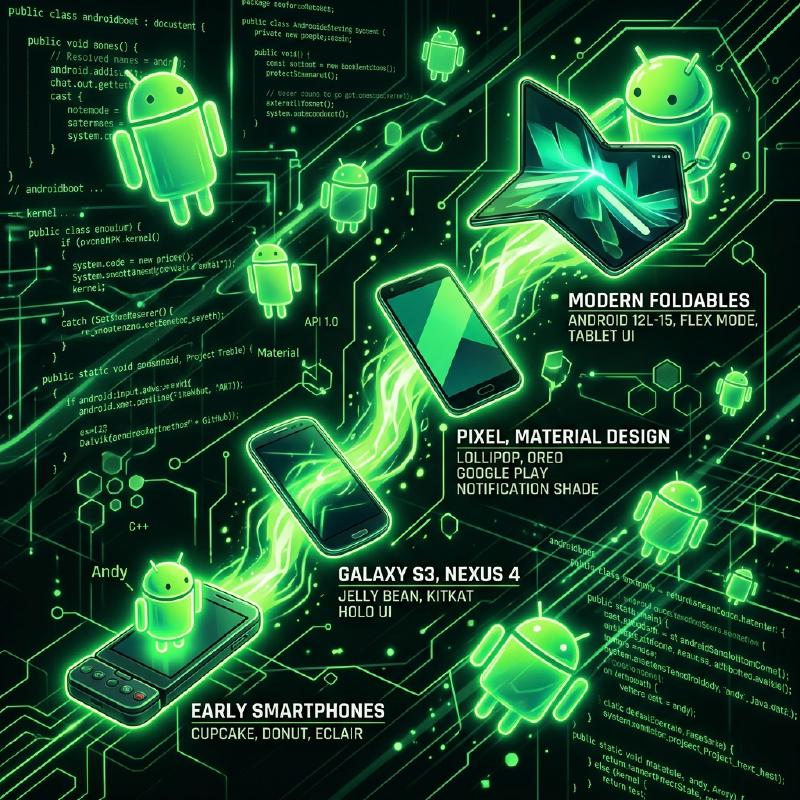
Indispensable in discussing the history of Android are the “sweet treat codenames”. Starting with “Cupcake” for Android 1.5, dessert names were given in alphabetical order: Donut, Eclair, Froyo, Gingerbread… In particular, “Android 4.0 (Ice Cream Sandwich),” released in 2011, is known as a groundbreaking version that unified the previously fragmented UI for smartphones and tablets, laying the foundation for modern Android.
5. The Leap Forward of Samsung “Galaxy” and the Patent War with Apple
Among the manufacturers provided with Android for free, the most successful was South Korea’s Samsung. The “Galaxy S” series reigned as a powerful rival to the iPhone, consistently leading hardware trends such as the gigantism of screens (phablets) and the adoption of OLED displays.
However, Apple could not stand idly by and watch the rapid expansion of Android. The late Steve Jobs was furious, saying, “Android is a stolen product of the iPhone. I’m willing to go thermonuclear war on this,” and a messy patent lawsuit (the smartphone patent war) broke out worldwide. This dispute continued for several years, but eventually settled with both companies, having grown too large, reaching an agreement.
6. Conclusion: The Two Great Giants of the Mobile Ecosystem
Currently, the smartphone market is practically a duopoly between Apple’s “iOS” and Google’s “Android”.
- iOS: A “beautiful walled garden” where Apple strictly manages hardware and software. High security and a uniform user experience.
- Android: An “open infrastructure” for manufacturers worldwide to create diverse devices (such as foldable smartphones and budget versions). Customizability and diversity.
The small project that once started as an OS for cameras grew into the most widely adopted operating system in human history, driven by Google’s philosophy of “making access to information free” and the power of open source.