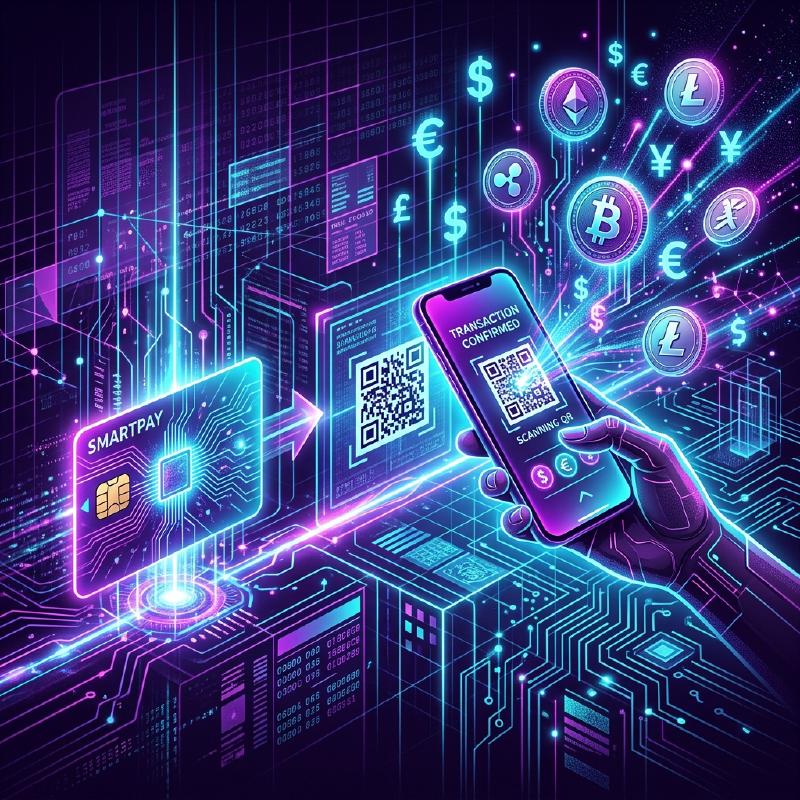
1. The Endless Challenge Towards the “Digitization” of Money
Throughout human history, money (currency) has evolved from shells to gold and silver coins, and eventually to state-guaranteed paper bills. All of these possessed a “physical reality.” However, in the late 20th century, as computers and networks began to develop, cryptographers and engineers held one grand dream. “Could we eliminate physical bills and coins, and exchange ‘money’ purely as digital data?”
This was the beginning of the history of “Electronic Money.”
2. David Chaum and the Dream of “DigiCash”
The first person to try to technically establish the concept of electronic money was the American cryptographer David Chaum. In the 1980s, he invented a groundbreaking cryptographic technique called the “Blind Signature.” This was a technology that allowed a bank to prove (sign) that money was authentic without knowing “who withdrew the money.” In other words, he attempted to create a digital currency with “complete anonymity” just like cash.
In 1990, he founded a company called “DigiCash” and issued “eCash,” the world’s first full-fledged electronic money. Some banks also participated in this experiment, and it seemed that the cyberpunk dream might become a reality. However, eCash required specialized software to use, and because the culture of shopping on the Internet was still immature at the time, the number of users did not increase at all, leading to the bankruptcy of DigiCash in 1998. The challenge of a genius who was ahead of his time ended in failure.
3. A Revolution from Japan: FeliCa and the Birth of “Suica”
While “anonymous electronic money” on the Internet came to a standstill, an electronic money revolution was occurring from an entirely different approach in the real world (offline). Its epicenter was Japan.
In the late 1990s, Sony engineers were developing FeliCa, a “contactless IC card technology.” Following its world-first successful implementation in the Hong Kong subway (Octopus card), JR East introduced “Suica” in 2001.
Unlike previous magnetic tickets that had to be “sucked into the ticket gate,” Suica, which deducted fares just by “holding it over for 0.1 seconds,” brought dramatic changes to Japan’s social infrastructure. The key to Suica’s success was that it focused on the overwhelming convenience of being able to “pass through crowded train ticket gates without stopping,” rather than on ideologies like anonymity.
Later, in 2004, NTT DoCoMo announced the “Osaifu-Keitai” (wallet mobile), creating the world’s first concept of mobile payments where “the mobile phone becomes a wallet” by embedding a FeliCa chip into mobile phones. Edy (now Rakuten Edy), nanaco, WAON, and others were born one after another, and Japan grew into a unique electronic money superpower ahead of the rest of the world.
4. Server-Managed Electronic Money and QR Code Payments
Electronic money using FeliCa (IC card type) was predominantly the “IC card type (prepaid),” where balance (value) data was stored inside the card.
However, due to the spread of smartphones and a dramatic improvement in network environments, from the 2010s onward, “server-managed electronic money” became mainstream, where “all balance data is managed on the cloud (server), and the smartphone screen merely acts as a key to display the server’s information.”
Prominent examples of this are QR code payments like “Alipay” and “WeChat Pay,” which exploded in popularity in China. Stores did not need to prepare expensive FeliCa reading terminals; they could introduce payments just by placing a QR code printed on paper. As a result, it spread rapidly from street stalls to high-end stores, transforming China into a “cashless society” in just a few years. This wave also reached Japan, leading to the rise of services like PayPay and LINE Pay.
5. The Return to Crypto Assets (Virtual Currencies)
Meanwhile, in the Internet world, the passion for a “digital currency without a central administrator,” which David Chaum dreamed of, had not disappeared.
In 2008, Bitcoin, announced by Satoshi Nakamoto, used blockchain technology and PoW (Proof of Work) to complete a digital currency that cannot be forged or double-spent, even without any specific companies or banks (central administrators) existing. Electronic money like Suica and PayPay are ultimately centralized systems based on “trusting the servers of the operating companies (JR or PayPay Corp),” whereas Bitcoin operates on a fundamentally different paradigm, being a “decentralized” system monitored mutually by all participants.
6. Conclusion: The Future of Digitized Value
The attempt to turn “currency into data” began with the failures of cryptographers in the 1990s, passed through practical application at Japanese ticket gates (FeliCa), evolved into cloud-based (QR code) payments due to the spread of smartphones, and finally reached the ultimate decentralized currency: the blockchain.
Currently, central banks around the world are fully researching “CBDC (Central Bank Digital Currency),” a digital fiat currency issued by the state itself. When money is completely replaced by “massless data,” how will our concept of “value” change? The history of electronic money is finally approaching its final chapter.