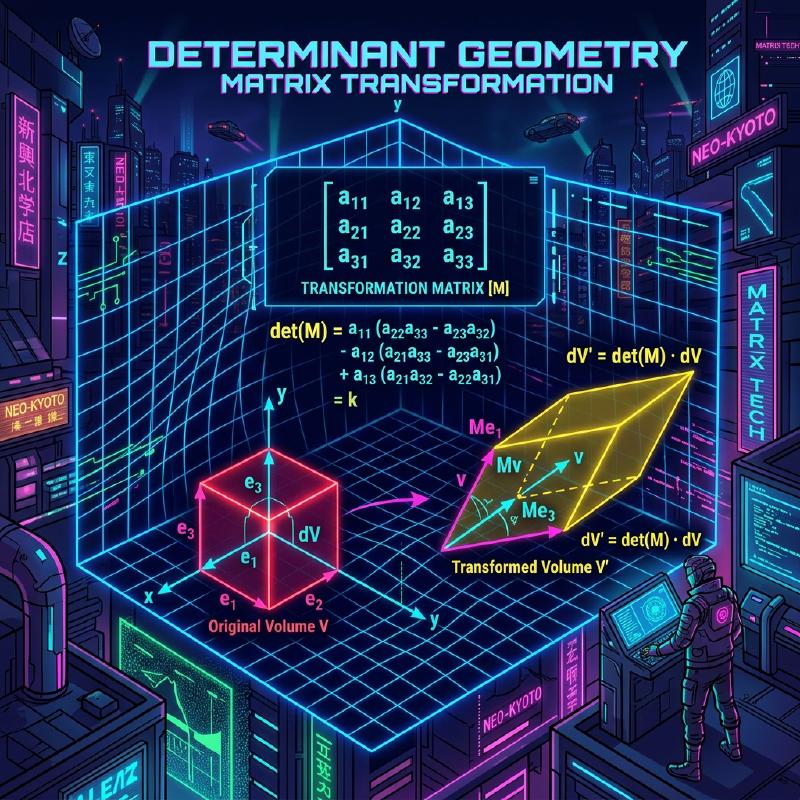
When learning linear algebra, one of the first stumbling blocks for many people is the determinant . Textbooks are filled with complex formulas and expansion rules, but its true nature is highly visual and intuitive. Many students know “how to calculate it” but miss the opportunity to understand “what it actually means.”
In this article, we will re-examine the determinant not simply as a “formula for finding a numerical value,” but from a geometric perspective as two crucial concepts: the volume scale factor of space and orientation reversal. Understanding this will completely change your view of the entire landscape of linear algebra.
1. What is a Determinant? (A Brief Review)
The determinant (commonly denoted as $\det(A)$ or $|A|$) is a special number defined for square matrices. As a basic example, consider a 2x2 matrix $A$ given as follows:
$$ A = \begin{pmatrix} a & b \\ c & d \end{pmatrix} $$In this case, the determinant is calculated as follows:
$$ \det(A) = ad - bc $$For 3x3 matrices, it is calculated using Sarrus’ rule or cofactor expansion, making the formula much more complex. You might be able to memorize these formulas themselves, but they don’t answer questions like “Why $ad - bc$?” or “Why such a complex sum and difference of products?” To fundamentally resolve this question, we need to visualize matrices as linear transformations (the skewing and stretching of space).
2. Geometric Meaning in 2D: Area Scale Factor
In 2-dimensional space (a plane), a matrix functions as a “transformation” that moves points on the plane to other points. Let’s see how a reference unit square (a square with an area of $1$ created by the basis vectors $\mathbf{i} = (1, 0)$ and $\mathbf{j} = (0, 1)$) is transformed by matrix $A$.
When matrix $A$ is applied, the standard basis vectors are transformed into $\mathbf{v}_1 = (a, c)$ and $\mathbf{v}_2 = (b, d)$ respectively. The area of the parallelogram formed by these two newly transformed vectors is exactly equal to the absolute value of the determinant, $|\det(A)|$.
  flowchart LR
    A["Unit square (Area 1)"] -->|"Linear transformation by matrix A"| B["Parallelogram (Area |det(A)|)"]
In other words, the absolute value of the determinant means the “area scale factor” that indicates how many times every figure in space has been stretched (or shrunk) by that linear transformation. For example, if the determinant of a matrix is $3$, the area of every figure drawn on the original plane will become exactly three times larger after the transformation.
Confirming with Concrete Examples
$$ M = \begin{pmatrix} 2 & 0 \\ 0 & 3 \end{pmatrix} $$This matrix represents a transformation that stretches the $x$-direction by 2 and the $y$-direction by 3. The determinant is $2 \times 3 - 0 = 6$, which perfectly aligns with our intuition that the area becomes 6 times larger.
$$ S = \begin{pmatrix} 1 & 1 \\ 0 & 1 \end{pmatrix} $$This is what is called a shear transformation. A square is distorted into a parallelogram, but since the base and height remain unchanged, the area also remains unchanged. Calculating the determinant gives $1 \times 1 - 1 \times 0 = 1$, mathematically confirming that the area is preserved.
3. Geometric Meaning in 3D: Volume Scale Factor
This powerful geometric concept naturally extends to 3-dimensional space. The determinant of a 3x3 matrix represents the volume of the parallelepiped formed by the three transformed basis vectors.
Expressed as a formula, it looks like this:
$$ \det(A) = \text{Volume of the transformed parallelepiped (signed)} $$If the determinant is $0.5$, it means the volume of the entire space is compressed by half. Even if the dimensions increase to $n$-dimensional space, the essence that “the determinant is the scale factor of $n$-dimensional volume” remains completely unchanged.
4. Negative Determinants and “Orientation Reversal”
Up until now, we have only focused on the “absolute value” of the determinant, but in actual calculations, determinants frequently take negative values. So, what on earth does it mean for an area or volume to become “negative”?
This signifies an orientation reversal of space. In 2D, it corresponds to an operation like “flipping over” a figure drawn on a transparent sheet. When the relative positional relationship of the basis vectors (whether they are clockwise or counterclockwise) is inverted, the determinant takes a negative value.
  flowchart TD
    Original["Original space (Right-handed)"]
    Reflected["Transformed space (Left-handed)"]
    Original -->|"Transformation with det(A) < 0"| Reflected
    Original -->|"Involves flipping the space"| Reflected
In 3D space, it means a conversion from a “right-handed system” to a “left-handed system”. Imagine the world reflected in a mirror. In the mirror world, your right hand becomes your left hand. When a transformation involving such a reflection occurs, the determinant becomes negative.
For example, the following matrix is a 2D matrix representing a reflection (flip) across the $x$-axis.
$$ A = \begin{pmatrix} 1 & 0 \\ 0 & -1 \end{pmatrix} $$The determinant of this matrix is $1 \times (-1) - 0 \times 0 = -1$. The absolute size of the area does not change (the scale factor is $1$), but because the space has been flipped, the sign has become negative.
5. When the Determinant is 0: Spatial Collapse and the Non-existence of an Inverse Matrix
Finally, let’s consider the extreme case where the determinant is exactly $0$. A scale factor of $0$ means that the transformed area or volume becomes $0$. What is happening to space in this case?
In 2D, it means that the two transformed basis vectors overlap on the same straight line, and the plane, which should originally be 2-dimensional, collapses into a 1-dimensional “line”. In 3D, a solid collapses completely into a “plane,” a “line,” or in the worst case, a “point.”
  flowchart LR
    Space["2D Plane"] -->|"Transformation with det(A) = 0"| Line["Compressed into a 1D line"]
A matrix whose determinant is $0$ has a very important algebraic property: it does not have an inverse matrix (it is a singular matrix). Geometrically, the reason is obvious. Once a space has collapsed into a lower dimension, it is impossible to supplement the lost information and restore the original higher-dimensional space (i.e., perform an inverse transformation).
6. Geometric Interpretation of Determinant Properties
Determinants have several well-known algebraic properties, but if you know their geometric meaning, you can understand them intuitively.
- Determinant of a product : $\det(AB) = \det(A)\det(B)$ The matrix product $AB$ means a composite transformation of “performing transformation $B$ and then performing transformation $A$”. The space is first expanded by $\det(B)$ times, and then further expanded by $\det(A)$ times, so it is naturally completely logical that the overall scale factor is their product.
- Determinant of an inverse matrix : $\det(A^{-1}) = \frac{1}{\det(A)}$ If a certain transformation expands space by $2$ times, its inverse transformation must shrink space by $\frac{1}{2}$ to return it to its original state.
7. Conclusion: Connecting to the Jacobian
The determinant is not just a cumbersome calculation formula, but an extremely powerful geometric tool for describing the deformation of space.
- Absolute value : The “scale factor” indicating how many times the area or volume of space is multiplied.
- Sign : Whether the “orientation” of space is preserved (positive) or reversed (negative).
- Zero : Space “collapsing” into a lower dimension (loss of dimensionality and irreversibility).
Having this intuitive image will serve as an important foundation for understanding the Jacobian (the local volume scale factor in non-linear transformations) that you will learn later in calculus. In the world of linear algebra, constantly linking formulas with geometric images is the shortest path to deep understanding.