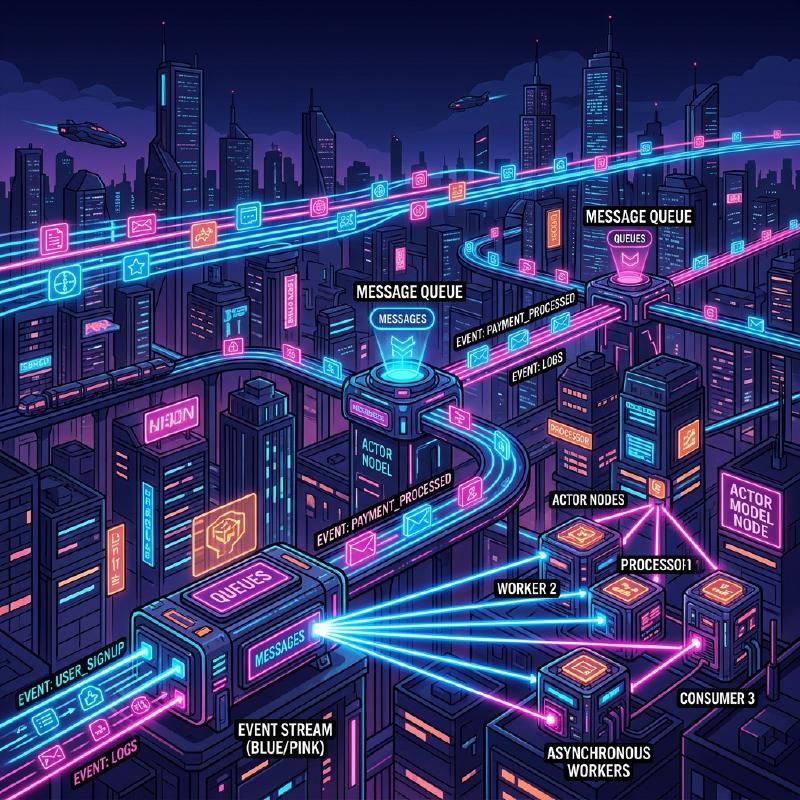
In modern software development, understanding asynchronous processing and Event-Driven Architecture (EDA) is essential for improving system scalability and availability. In this article, we will delve deeply into the core concepts supporting these: the Event Loop, the Actor model, and CQRS (Command Query Responsibility Segregation), from theory to implementation and architectural level design.
1. Basics and Challenges of Asynchronous Processing
In a traditional synchronous processing model, the next task is blocked until a given task is completed. While this is simple as a programming model, it has the drawback of wasting CPU resources during I/O waits (such as database accesses or network requests).
Asynchronous processing is a technique to avoid this blocking and dramatically improve system throughput. However, introducing asynchronous processing brings new challenges such as state management, error handling, and race conditions between threads.
1.1 Comparison of Synchronous and Asynchronous Models
  sequenceDiagram
    participant Client
    participant Server
    participant Database

    Note over Client,Database: "Synchronous Processing Model (Blocking)"
    Client->>Server: "Send Request"
    Server->>Database: "Execute Query"
    activate Database
    Note over Server: "Server waits for response (blocked)"
    Database-->>Server: "Return Result"
    deactivate Database
    Server-->>Client: "Return Response"

    Note over Client,Database: "Asynchronous Processing Model (Non-blocking)"
    Client->>Server: "Send Request"
    Server->>Database: "Execute Query (Asynchronous)"
    Note over Server: "Server can execute other tasks"
    Database-->>Server: "Callback / Event Notification"
    Server-->>Client: "Return Response"
In the asynchronous model, wait time can be utilized effectively, allowing more requests to be processed simultaneously. Representative approaches for achieving this concurrency are the Event Loop and the Actor model.
2. Asynchronous Processing with Event Loop (Node.js / JavaScript)
The Event Loop is a mechanism for achieving high concurrency while remaining single-threaded. It is widely adopted in Node.js and browser environments (JavaScript).
2.1 Event Loop Architecture
The Event Loop operates as an infinite loop on the main thread, sequentially executing callback functions stacked in the task queue. Time-consuming I/O processes are delegated to the OS’s asynchronous APIs or worker threads (thread pool), and upon completion, callbacks are added to the queue.
  flowchart TD
    A["Call Stack"] -->|"Asynchronous Processing"| B("Web APIs / C++ APIs")
    B -->|"Completion Notification"| C["Callback Queue / Task Queue"]
    C -->|"Event Loop"| A

    subgraph EventLoopMechanism["Event Loop Mechanism"]
        A
        B
        C
    end
2.2 Implementation Example in JavaScript
The following code is a typical example of asynchronous processing (Promise and async/await) in JavaScript.
| |
The advantage of the Event Loop is that it does not require lock management for shared states. However, if heavy CPU-bound processing is executed on the Call Stack, the entire Event Loop will be blocked, posing a risk of the system coming to a halt (Event Loop blocking). Computational complexity should be kept to lightweight operations of $ O(1) $ to $ O(N) $.
3. Actor Model and Message Passing (Rust / Erlang / Akka)
If the Event Loop is an approach that challenges the limits of a single thread, the Actor model is a paradigm for making concurrent processing in multi-threaded or distributed environments safe and scalable.
3.1 Basic Concepts of the Actor Model
In the Actor model, the basic unit of processing is called an “Actor”. Each Actor has an independent state and behavior, and does not directly share state with other Actors. Communication between Actors is entirely done through asynchronous message passing.
- State Encapsulation: The internal state of an Actor cannot be accessed directly from the outside.
- Message Queue (Mailbox): Received messages are queued in the Mailbox and processed sequentially.
- Lock-free: Because states are not shared, lock mechanisms like mutexes are unnecessary.
  flowchart LR
    A["Actor 1"] -->|"Message"| B("Mailbox")
    B --> C["Actor 2"]
    C -->|"Message"| D("Mailbox")
    D --> A

    subgraph ActorSystem["Actor System"]
        A
        C
    end
3.2 Actor Implementation Example using Rust
In Rust, a systems programming language, you can build an Actor model using powerful asynchronous crates such as tokio and actix. Here, we show a simple Actor pattern implementation using an mpsc (Multi-Producer, Single-Consumer) channel.
| |
Ownership and the type system in Rust guarantee the safety of message passing between Actors at compile time. If we express the system throughput as $ S $ in a mathematical formula, for an actor count $ N $ and message processing rate $ R $, it ideally becomes $ S = N \times R $, demonstrating high scalability.
4. Into the World of Event-Driven Architecture (EDA)
Asynchronous processing and the Actor model are techniques for optimizing concurrent processing within a single application. The concept that extends this to the entire system (such as between microservices) is Event-Driven Architecture (EDA).
In EDA, state changes within the system are expressed as “events” and asynchronously delivered through an event bus or message broker (Apache Kafka, RabbitMQ, AWS EventBridge, etc.).
4.1 Key Components of EDA
- Event Producer: A component that generates events and sends them to the broker.
- Message Broker: The infrastructure that routes, accumulates, and delivers events.
- Event Consumer: A component that receives events and executes asynchronous processing.
  flowchart LR
    P1["Order Service"] -->|"OrderCreated Event"| MB(("Message Broker"))
    P2["Payment Service"] -->|"PaymentProcessed Event"| MB
    MB -->|"Subscribe"| C1["Inventory Service"]
    MB -->|"Subscribe"| C2["Notification Service"]
The greatest benefit of this architecture is Loose Coupling. Producers do not need to be aware of the existence of consumers, and even if part of the system goes down, the broker retains the events, improving resilience.
5. CQRS and Event Sourcing
When pushing event-driven architecture to its limits, you will notice that the requirements for writing data (Command) and reading data (Query) differ significantly. The pattern that solves this is CQRS (Command Query Responsibility Segregation).
5.1 CQRS Architecture
In CQRS, the system is physically and logically separated into a “Command Model that changes state” and a “Query Model that retrieves data”.
- Command Model: Handles complex business logic and validation, ensuring data consistency.
- Query Model: Provides denormalized data (Read Model) optimized for reading, enabling fast query responses.
  flowchart TD
    Client["Client"] -->|"Command (Write)"| CommandAPI["Command Service"]
    Client -->|"Query (Read)"| QueryAPI["Query Service"]

    CommandAPI -->|"Update"| WriteDB[("Write DB")]
    WriteDB -->|"Domain Events"| EventBus(("Event Bus"))
    EventBus -->|"Consume & Project"| ProjectionWorker["Projection Worker"]
    ProjectionWorker -->|"Update"| ReadDB[("Read DB")]
    ReadDB -->|"Fetch"| QueryAPI
5.2 Combining with Event Sourcing
CQRS shows its true value when combined with Event Sourcing. In traditional database design, only the “current state” of an entity is saved. However, in Event Sourcing, the “history of events that changed the state” is all saved (Append-only), and the current state is restored by sequentially replaying them.
For example, a bank account balance (current state) can be expressed as an accumulation of the following events.
$ Balance = \sum_{i=1}^{n} (Deposit_i) - \sum_{j=1}^{m} (Withdrawal_j) $
The benefits of Event Sourcing are as follows:
- Complete Audit Log: The state at any given point in the past can be restored and verified.
- Time Travel: A new Query Model (Read DB) can be built from scratch based on past events.
- Improved Write Performance: It is fast because it only appends events rather than updating the DB.
6. Use Cases and Architecture Selection
The technologies we have looked at so far each have their suitable use cases.
- Event Loop (Node.js):
- API gateways and real-time chat systems with many I/O-bound processes.
- WebSocket servers handling massive concurrent connections.
- Actor Model (Rust / Akka):
- Concurrent processing with complex state (game servers, real-time tracking).
- High availability systems requiring self-healing capabilities from errors (Supervisor Trees).
- CQRS / Event Sourcing:
- Domains where audit logs and high scalability are essential, such as financial systems and e-commerce order management.
- Systems with asymmetric read and write loads.
6.1 Challenges and Best Practices
While event-driven and asynchronous architectures are powerful, it is necessary to accept Eventual Consistency. Because data is not instantly reflected across all systems (strong consistency), ingenuity on the UI/UX side (e.g., optimistic UI updates) is required.
Additionally, ensuring Idempotency in distributed systems is crucial. Systems must be designed so that even if the same event is processed multiple times due to network retries, the result remains the same.
7. Summary
In this article, we explained the depths of event-driven architecture and asynchronous processing from the following perspectives:
- The mechanism of single-threaded, non-blocking I/O via the Event Loop.
- Safe and scalable message passing using the Actor model.
- Loose coupling and scalability between systems via EDA.
- Optimization of read/write and complex domain modeling through CQRS and Event Sourcing.
These technologies serve as powerful weapons for building modern cloud-native distributed systems. Selecting and combining the appropriate paradigms according to system characteristics and business requirements is the first step toward excellent architectural design.