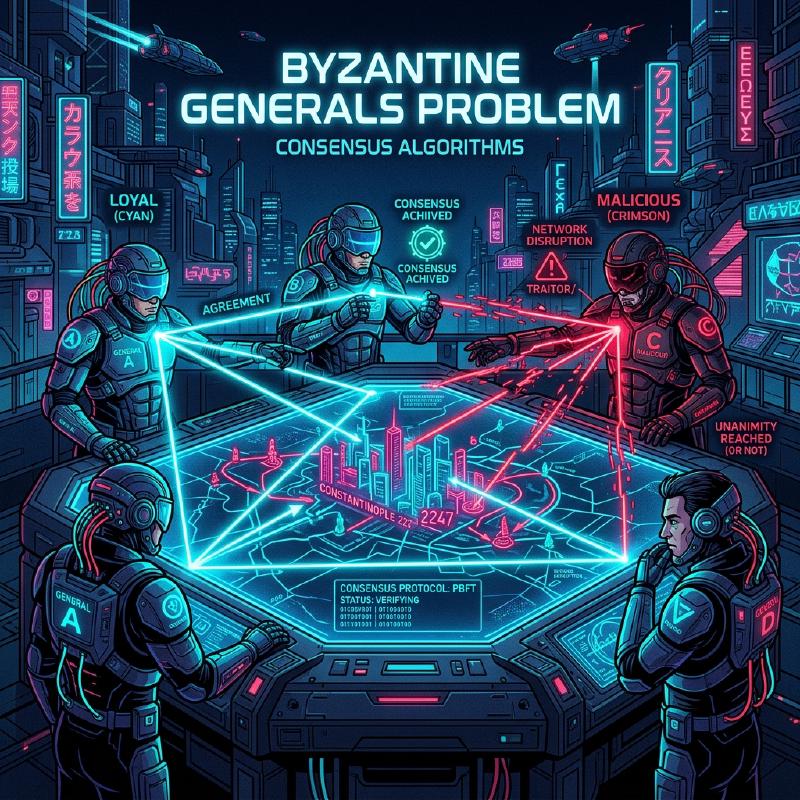
At the core of modern cloud computing and blockchain technologies lies the consensus algorithm, which allows multiple computers (nodes) to share and agree on a state. In this article, we will delve deeply into its theoretical foundation, the “Byzantine Generals Problem,” and explore Paxos and Raft, which are widely adopted in practical systems, as well as BFT (Byzantine Fault Tolerance) in environments where malicious participants exist. We will include mathematical proofs and code implementations.
1. Consensus and Challenges in Distributed Systems
In distributed systems, various failures that cannot occur on a single computer, such as network delays, packet loss, node crashes, or malicious tampering, can occur. Consensus algorithms are the mechanism for maintaining a consistent state across the entire system while withstanding these failures.
The fault tolerance of a system is mainly classified into the following two types:
- CFT (Crash Fault Tolerance) : Can withstand node stops (crashes) and network partitions, but does not assume nodes sending false data (malicious behavior).
- BFT (Byzantine Fault Tolerance) : Can withstand not only node stops but also situations where malicious nodes send arbitrary incorrect messages.
The concept of BFT originated from the famous Byzantine Generals Problem.
2. Byzantine Generals Problem
Proposed in 1982 by Leslie Lamport, Robert Shostak, and Marshall Pease, the “Byzantine Generals Problem” models how loyal participants can reach a consensus in a network mixed with malicious participants.
2.1 Definition of the Problem
Generals of the Byzantine Empire are besieging an enemy city. They are geographically separated and can only communicate through messengers. The generals must agree on a common plan of action, either to “attack” or “retreat.” However, there are traitors (malicious nodes) among the generals who might send false messages to confuse the other generals.
The conditions that the loyal generals must satisfy are as follows:
- All loyal generals must agree on the same plan of action (attack or retreat).
- A small number of traitors must not cause the loyal generals to adopt a bad (or inconsistent) plan.
2.2 Mathematical Formulation and Impossibility
Let $ n $ be the total number of generals and $ f $ be the number of traitors. Lamport and colleagues mathematically proved that if messages can be forged (unsigned messages), consensus is impossible unless the following condition is met:
$ n > 3f $
In other words, the total number of nodes must be strictly greater than three times the number of traitors. Conversely, if $ 1/3 $ or more of all nodes are malicious, the system cannot reach a secure consensus.
As an example, consider the case where $ n = 3 $ and $ f = 1 $. There are Generals A (Commander), B, and C, and A is the traitor. A tells B to “attack” and C to “retreat.” B and C exchange the messages they received from A, but B claims “A told me to attack,” while C claims “A told me to retreat.” At this point, it becomes impossible for B and C to determine whether the other is lying or if A is lying.
Below is a Mermaid diagram showing this impossible case of $ n = 3 $.
  graph TD
    A(("Commander A<br/>Traitor")) -->|"Attack"| B(("General B<br/>Loyal"))
    A -->|"Retreat"| C(("General C<br/>Loyal"))
    B -->|"A said Attack"| C
    C -->|"A said Retreat"| B
    style A fill:#ff9999,stroke:#ff0000,stroke-width:2px
3. Paxos: The Monument of Theoretical Consensus
In the realm of CFT (Crash Fault Tolerance), which does not consider Byzantine faults, the first powerful algorithm is Paxos. Also proposed by Leslie Lamport in 1989 (published in 1998), it is used in Google’s Chubby, Spanner, and others.
3.1 Roles and Phases in Paxos
Paxos consists of multiple Proposers, Acceptors, and Learners. Basic Paxos (Single-Decree Paxos) is a process for agreeing on a single value and is divided into the following two phases.
- Phase 1: Prepare (Preparation)
- A Proposer chooses a unique proposal number $ n $ and sends a
Prepare(n)request to a majority of Acceptors. - If $ n $ is greater than any
Preparenumber the Acceptor has received so far, it promises not to accept any proposals numbered less than $ n $ in the future, and responds with the highest-numbered proposal it has accepted, if any.
- A Proposer chooses a unique proposal number $ n $ and sends a
- Phase 2: Accept (Acceptance)
- When the Proposer receives responses from a majority of Acceptors, it sends an
Accept(n, v)request. Here, $ v $ is the value of the highest-numbered proposal among the responses, or the Proposer’s own value if no proposals were returned. - The Acceptor accepts the proposal unless it has already promised not to for a higher proposal number.
- When the Proposer receives responses from a majority of Acceptors, it sends an
3.2 Paxos Simulation in Python
Below is Python code that simplifies and simulates the behavior of Paxos Phase 1 and Phase 2.
| |
4. Raft: An Algorithm Designed for Understandability
While Paxos is extremely powerful, its algorithm is complex, making practical implementation difficult. Therefore, in 2014, Diego Ongaro and John Ousterhout designed Raft with a primary focus on “Understandability”. It is currently widely used in systems like etcd and Consul.
4.1 Core Concepts of Raft
Raft divides the problem of maintaining system state into two subproblems: Leader Election and Log Replication.
Nodes are always in one of the following three states:
- Leader : Receives requests from clients and replicates logs to other nodes.
- Follower : Obeys requests from the leader.
- Candidate : A state a node enters to run for a new leader when the current leader fails.
  stateDiagram-v2
    state "Follower" as Follower
    state "Candidate" as Candidate
    state "Leader" as Leader
    [*] --> Follower
    Follower --> Candidate : "Timeout occurred"
    Candidate --> Candidate : "Election timeout"
    Candidate --> Leader : "Receives majority of votes"
    Candidate --> Follower : "Discovers new leader"
    Leader --> Follower : "Discovers higher Term"
4.2 Leader Election Mechanism
Raft uses a logical clock called a Term. Each follower has a randomized Election Timeout. If heartbeats from the leader stop and a timeout occurs, the node becomes a Candidate and requests votes for itself (RequestVote). The node that receives a majority of votes becomes the new Leader. By randomizing timeouts, Raft prevents split votes.
4.3 Type Definition of Raft Node State in Haskell
Modeling Raft state transitions using a functional programming language clarifies its robustness. Below is an example of simplified type definitions in Haskell.
| |
By describing state transitions as pure functions in this way, verifying the correctness of Raft’s logic becomes much easier.
5. Practical Byzantine Fault Tolerance: PBFT
Paxos and Raft are CFT (crash-tolerant), but they are powerless when malicious nodes exist in the network. To address this problem (the Byzantine Generals Problem) with practical performance, Miguel Castro and Barbara Liskov introduced PBFT (Practical Byzantine Fault Tolerance) in 1999.
5.1 Communication Phases of PBFT
In PBFT, there is a leader (Primary) and followers (Backups). The system uses the following three-phase multicast communication for client requests:
- Pre-prepare : The Primary assigns a sequence number to the request and broadcasts it to all nodes.
- Prepare : Upon receiving the request, each node verifies it and broadcasts a
Preparemessage to all other nodes. Once a node receives $ 2f $Preparemessages, it enters the Prepared state. - Commit : Nodes in the Prepared state broadcast a
Commitmessage to all nodes. When $ 2f + 1 $Commitmessages are received, consensus is achieved, and the request is executed.
  sequenceDiagram
    participant C as "Client"
    participant P as "Primary"
    participant B1 as "Backup 1"
    participant B2 as "Backup 2"
    participant B3 as "Backup 3 (Malicious)"

    C->>P: "Request"
    P->>B1: "Pre-prepare"
    P->>B2: "Pre-prepare"
    P->>B3: "Pre-prepare"

    Note over P,B3: "Prepare phase (O(N^2) communication)"
    B1->>P: "Prepare"
    B1->>B2: "Prepare"
    B2->>P: "Prepare"
    B2->>B1: "Prepare"

    Note over P,B3: "Commit phase (O(N^2) communication)"
    P->>B1: "Commit"
    B1->>B2: "Commit"
    B2->>P: "Commit"

    P->>C: "Reply"
    B1->>C: "Reply"
    B2->>C: "Reply"
PBFT operates with a node configuration of $ n = 3f + 1 $, fulfilling the aforementioned condition of $ n > 3f $. It incurs an $ O(N^2) $ communication overhead between nodes but provides deterministic finality. This is widely adopted in modern consortium blockchains (such as Hyperledger Fabric).
5.2 Re-verification of Mathematical Constraints
For PBFT to maintain safety, it assumes that messages exchanged within the system are cryptographically secure (unforgeable). Let the size of a Quorum be $ Q $. The following conditions must be met:
$ Q = 2f + 1 \\\\ n = 3f + 1 $
The intersection of any two quorums $ Q_1 $ and $ Q_2 $ must contain at least one honest node: $ |Q_1 \cap Q_2| = 2Q - n = 2(2f + 1) - (3f + 1) = f + 1 $ In this way, even if $ f $ malicious nodes belong to both quorums, there is always at least one honest node included, thereby proving the consistency of the entire system.
6. Conclusion: The Evolution of Consensus Algorithms
In this article, we explained consensus formation, the greatest challenge in distributed systems, starting from the theoretical “Byzantine Generals Problem,” moving to crash-tolerant Paxos and Raft, and covering PBFT, which is resistant to malicious nodes.
- Paxos : A mathematically proven, robust foundation, though complexity is an issue.
- Raft : Pursues understandability and ease of implementation, becoming the de facto standard for modern distributed KVS.
- PBFT : Achieves deterministic consensus in environments mixed with malicious nodes, forming the foundation of blockchain technology.
Today, new BFT algorithms like the Nakamoto Consensus (PoW) adopted by Bitcoin, Tendermint, and HotStuff continue to emerge, reducing the communication overhead of PBFT while improving scalability. Selecting the appropriate consensus algorithm based on system requirements (node reliability, required throughput, latency) is the key to building a robust distributed system.