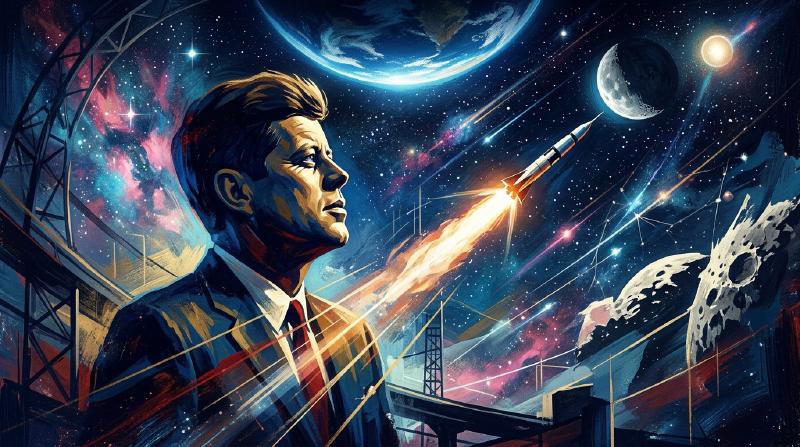
John Fitzgerald Kennedy (JFK), the 35th President of the United States, was a charismatic leader who guided the nation through the historical turning point of the Cold War. Although his time in office was a brief 1,036 days, his philosophy and actions continue to inspire people around the world today. This article delves into his life, his core philosophy, and his immeasurable impact up to the present day.
From a Privileged Background to War Hero
Born on May 29, 1917, into a wealthy Irish Catholic family in Brookline, Massachusetts, Kennedy grew up in a family environment that valued intellectual competition, despite being sickly from childhood. After graduating from Harvard University, he joined the Navy when World War II broke out.
In 1943, the torpedo boat “PT-109” he commanded collided with a Japanese destroyer and sank, placing him in a desperate crisis. However, despite being injured, he led his subordinates and swam several kilometers to an island in a heroic rescue. This experience became the starting point of his “indomitable spirit” and “calm judgment” in the face of national crises he would later encounter.
Advocating the “New Frontier” and Assuming the Presidency
After the war, prompted by the death of his older brother Joseph in combat, Kennedy began his path as a politician, serving as a Representative and Senator before running in the 1960 presidential election. Skillfully utilizing the new medium of television debates, he narrowly defeated Richard Nixon to be elected as the youngest and first Catholic president in history.
His words in his inaugural address, “Ask not what your country can do for you—ask what you can do for your country,” strongly resonated with the American people, especially the youth. He proposed the “New Frontier” policy, boldly tackling unresolved domestic issues such as the eradication of poverty, the enhancement of education, and the abolition of racial discrimination.
Crisis Management in the Cold War: The Cuban Missile Crisis
The greatest trial of the Kennedy administration was the “Cuban Missile Crisis” that occurred in October 1962. When it was discovered that the Soviet Union was building nuclear missile bases in Cuba, the world stood on the brink of World War III, a full-scale nuclear war.
While the military strongly advocated for hardline measures such as airstrikes or invasion of Cuba, Kennedy chose the restrained but firm measure of a naval blockade. After tense exchanges of letters and behind-the-scenes negotiations with Soviet Premier Khrushchev, the Soviet Union agreed to remove the missiles. Resolving this crisis peacefully proved his extraordinary self-restraint and belief in dialogue.
The Apollo Program: The New Frontier of Space
Kennedy’s future-oriented mindset is best symbolized by his challenge to space exploration. In 1961, he declared a magnificent goal to Congress: “before this decade is out, of landing a man on the moon and returning him safely to the earth” (the Apollo Program).
Although it seemed a reckless goal given the technological level of the time, he inspired the nation by saying, “We choose to go to the moon in this decade and do the other things, not because they are easy, but because they are hard.” This decision went beyond a mere space race during the Cold War, generating a massive wave of innovation that pushed human potential to the limit. The dream he envisioned became a reality in 1969, after his death, with the Apollo 11 moon landing.
Tragic End and Lasting Impact
On November 22, 1963, while campaigning in Dallas, Texas, Kennedy was struck down by an assassin’s bullet. The sudden assassination brought deep sorrow and shock not only to America but to the entire world, marking the end of an era.
However, his legacy did not fade. His strong support for the civil rights movement culminated in the passage of the Civil Rights Act of 1964 under the succeeding Johnson administration. Furthermore, the “Peace Corps,” established to support developing nations, remains a foundation for many young Americans volunteering worldwide today.
At the core of Kennedy’s philosophy was a delicate balance of “idealism” and “realistic approaches.” While desiring peace, he maintained strong military power and actively embraced new technologies and ideas without fear of change. In the “modern new frontiers” we face today—such as climate change, international conflicts, and rapid technological advancement—his spirit of “challenging the unknown” and “civic solidarity” can serve as a vital compass.
Correlation Chart of Kennedy’s Life and Achievements
The diagram below shows the key events in Kennedy’s life and how his policies connected to his enduring legacy.
  flowchart TD
    A["Birth & Early Life (1917-)"] --> B["WWII Service: PT-109 Heroism (1943)"]
    B --> C["Political Career Begins (1946-)"]
    C --> D["35th US President (1961)"]

    D --> E{"Key Policies & Challenges"}

    E --> F["New Frontier Policy"]
    E --> G["Apollo Program (1961)"]
    E --> H["Cuban Missile Crisis (1962)"]
    E --> I["Support for Civil Rights"]

    F --> J["Peace Corps Establishment"]
    G --> K["Moon Landing (1969)"]
    H --> L["Nuclear Test Ban Treaty (1963)"]
    I --> M["Civil Rights Act (1964)"]

    J --> N["Assassination in Dallas (1963)"]
    K --> N
    L --> N
    M --> N

    N --> O["Enduring Legacy & Inspiration"]
John F. Kennedy was not a perfect man, but he was a leader who embodied the hopes of America’s brightest era. The words and vision he left behind continue to push forward all those who believe in a better future, transcending time.