
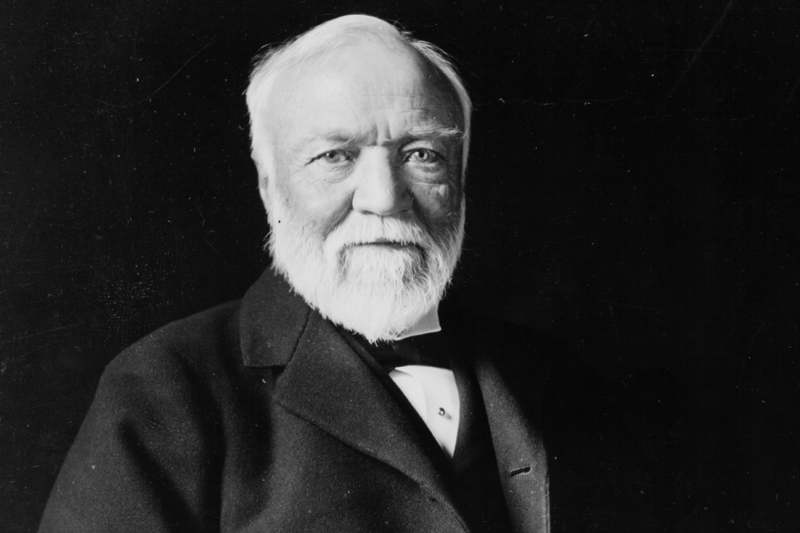
Andrew Carnegie
Andrew Carnegie (1835-1919), the “Steel King” who represented the American Industrial Revolution. His life is told as a typical “American Dream” where a poor immigrant from Scotland built immense wealth, while he also possessed the aspect of a philanthropist who advocated the “Gospel of Wealth” and gave away his fortune to society. In this article, we delve deeply into his dramatic life, his philosophy that is inherited today, and his impact on later generations.
Starting from Poverty and Rising in the World
Andrew Carnegie was born in Dunfermline, Scotland, in 1835. His father was a handloom weaver, but swallowed by the wave of mechanization brought by the Industrial Revolution, the family was forced into severe poverty. In 1848, seeking a new world, the family emigrated to Allegheny, Pennsylvania (now part of Pittsburgh) in the United States.
Starting to work as a bobbin boy in a spinning mill at the age of 13, Carnegie started his career with a weekly wage of only 1.20 dollars. However, his strong intellectual curiosity and diligence quickly caught the eyes of those around him. After working as a telegraph messenger, he got a job at the Pennsylvania Railroad. He mastered the telegraph technology, which was the cutting-edge technology at the time, and rapidly climbed the ladder of success. Receiving the patronage of his boss Thomas A. Scott and learning the know-how of investment, he foresaw the future potential of bridge building and the steel industry, and began to pave his way to independence.
The Road to the “Steel King”: The Breakthrough of the Carnegie Steel Company
After the Civil War, America entered an era of rapid industrialization. Predicting that the demand for steel would explosively increase with the expansion of the railway network and urbanization, Carnegie quickly introduced the Bessemer process (a mass production technology for steel).
He established the Carnegie Steel Company in 1892 and established a groundbreaking business model called “vertical integration,” which consistently performed everything from raw material mining to transportation, manufacturing, and sales. Through thorough cost reduction and efficiency improvements, the company grew into the world’s largest steelmaker. Carnegie thoroughly practiced the philosophy of “produce at the cheapest cost and sell at the most reasonable price,” and generated enormous profits.
However, behind that success, there was also a dark shadow of harsh working conditions for workers and tragic labor disputes like the Homestead Strike of 1892. His face as a cold-blooded business manager created a strong contrast with the philanthropic activities he later practiced.
Philosophy “The Gospel of Wealth”: From Ownership to Distribution
Symbolizing Carnegie’s philosophy is the essay “The Gospel of Wealth” published in 1889. In it, he argued that “the wealthy are merely holding property temporarily from society, and they have a moral obligation to return that wealth for the benefit of society.” His words, “the man who dies thus rich dies disgraced,” demonstrate a unique capitalist philosophy that draws a line from mere money-making.
In 1901, at the age of 65, Carnegie sold his steel company to financial king J.P. Morgan for 480 million dollars (worth hundreds of billions of dollars today) and completely retired from the business world. From then on, he devoted the rest of his life to “distribution” to practice his own philosophy.
Giving Back to Society and Legacy
After retiring from the business world, Carnegie generously invested his assets for the development of education, peace, and culture.
One of his most famous philanthropic endeavors is the construction of public libraries. Based on the belief that “knowledge should be open to all,” he established over 2,500 “Carnegie Libraries” not only in the United States but around the world, including the UK and Canada.
Furthermore, his contributions were wide-ranging, including the founding of educational institutions that became the predecessor of Carnegie Mellon University, the construction of Carnegie Hall, and the establishment of the Carnegie Endowment for International Peace to promote international peace. His total donations amounted to 350 million dollars at the time, which was equivalent to about 90% of his personal fortune.
  graph TD
    A["Andrew Carnegie"] -->|"1. Rising from poverty"| B["Experience in railroad and telegraph industries"]
    B -->|"2. Foresight"| C["Establishment of Carnegie Steel Company"]
    C -->|"Vertical integration and efficiency"| D["Accumulation of immense wealth (Steel King)"]
    D -->|"Business sale (1901)"| E["Dedication to philanthropy"]

    A -->|"Unique philosophy"| F["Essay The Gospel of Wealth"]
    F -->|"Moral obligation"| E

    E -->|"Educational support"| G["Establishment of over 2500 public libraries"]
    E -->|"Cultural support"| H["Construction of Carnegie Hall"]
    E -->|"Academic and Peace"| I["Carnegie Mellon University / Endowment for International Peace"]
The Significance of Carnegie in the Modern Era
Andrew Carnegie’s life embodies the light and shadow of capitalism. While monopolizing wealth as a cold-hearted businessman, his actions of generously giving away that wealth for the progress of humanity have influenced many modern billionaires like Bill Gates and Warren Buffett, becoming the spiritual pillar of donation activities by the wealthy, such as the “Giving Pledge.”
Believing in the spirit of self-help that “God helps those who help themselves,” Carnegie provided places to learn how to fish (libraries and schools) rather than just giving people fish. His legacy continues to shine brightly everywhere in society even more than a century later.