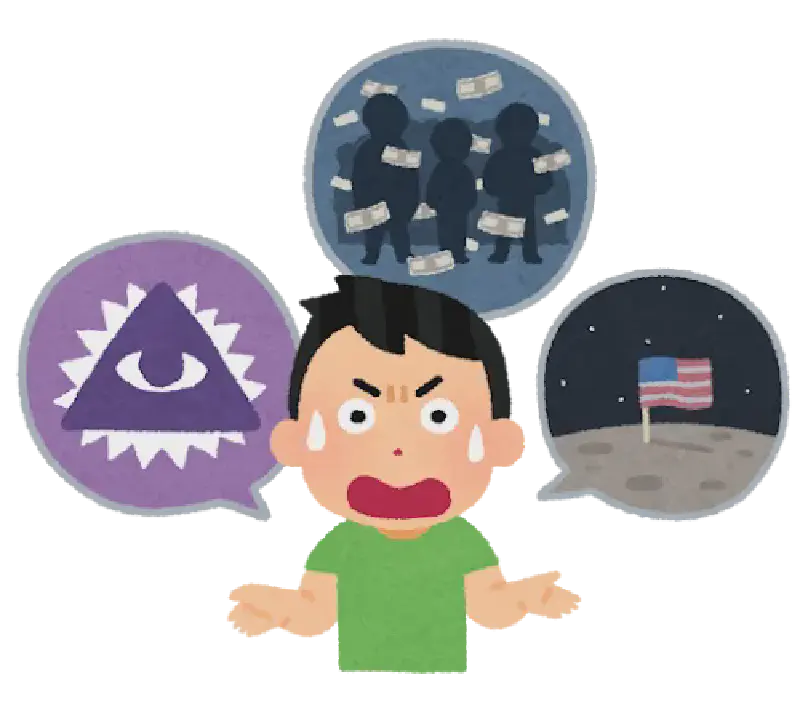
“Mental Security” Needed to Avoid Being Drawn into Conspiracy Theories
When browsing the internet, you may sometimes come across “conspiracy theory”-like stories.
“Isn’t there someone operating behind the scenes of this event?” “Could the real truth be hidden?” Many of you have probably seen such narratives spread in a plausible manner.
To avoid being drawn too deeply into such information, it is very important to develop not only “knowledge” and “thinking skills” but also your state of mind —in other words, your “mental security.”
Here are six effective ways of thinking for this purpose.
Do Not Immediately Connect Anxiety with an “Answer”
A major characteristic of conspiracy theories is that they present a clear and simple “answer” to anxieties and questions.
For example, to questions like:
- “Why did such an incident happen?”
- “Who is benefiting from this?”
When a plot like “Actually, XX is manipulating things behind the scenes” is shown, it is easy to inadvertently be convinced.
However, especially when you feel anxious, it is important to reserve judgment and not jump to conclusions right away.
The “ability to remain in a state of not knowing” is a sign of intellectual maturity.
Intentionally Broaden Your Information Sources
Many people who fall deep into conspiracy theories tend to intensively view only “information with similar perspectives.”
This is called “confirmation bias,” a psychological bias where one is exposed only to information that reinforces one’s existing beliefs.
In particular, the algorithms of social media and video sites constantly push posts that seem to match your preferences, which can naturally narrow your perspective.
Consciously aiming for a diversification of information sources can help avoid this risk, such as:
- Accessing media with different viewpoints
- Viewing overseas news and academic sources
- Listening to opinions that differ from your own
Do Not Think “I Won’t Be Fooled”
People who are knowledgeable or logical can actually be more susceptible to being drawn into conspiracy theories.
If you assume, “I can notice the truth that others don’t,” that becomes a factor that clouds your judgment.
No matter how careful you are, humans make mistakes. That is exactly why acting on the premise that you too might be fooled can be considered a more rational attitude.
“Doubting, yet not jumping to conclusions” becomes your defense.
Look at the Structure, Without Being Pulled by the Story
Conspiracy theories always come with a “dramatic narrative.”
- The conflict between good and evil
- Rulers and the ruled
- The awakened self vs. the brainwashed others
Such simple dichotomies may be attractive as a story, but they do not necessarily reflect reality correctly.
Real-world events and social movements involve a tangle of many elements, such as complex causal relationships, historical backgrounds, and institutional structures.
It is important to have a perspective that understands structurally “why things are the way they are,” without getting too emotionally pulled into the story.
Do Not Leave Loneliness Unaddressed
Behind the strong attraction to conspiracy theories, there may be hidden “isolation” or a “lack of a place to belong.”
When people feel lonely, they become deeply dependent on individuals or groups that understand them. Conspiracy theory communities can sometimes function as that “place to belong.”
Therefore, making efforts not to become lonely also contributes to your mental security.
For example, actions such as:
- Having regular conversations with people
- Joining communities where you can share hobbies and interests
- Having connections offline, not just online
can lead to mental stability.
Focus on Dialogue Rather Than Denial
Even if someone close to you leans toward conspiracy theories, denying them outright can backfire.
When their beliefs are denied, people tend to psychologically protect them (known as “defensive cognition”).
Instead, taking a dialogue-based approach can create the possibility of naturally broadening the other person’s perspective:
- Asking carefully, “What made you think that?”
- Gently offering your own perspective, such as “There might be this way of thinking too.”
Conclusion: What You Can Do to Keep Your Distance from Conspiracy Theories
- Have the ability to suspend judgment and not immediately connect anxiety with answers
- Diversify information sources and be aware of biases
- Recognize that your own judgment is not absolute
- Look at things through structures and causal relationships, not stories
- Avoid loneliness and maintain connections
- Face others’ conspiracy theories with dialogue rather than denial
It is said that whether one is attracted to conspiracy theories is influenced more by psychological states and environmental factors than by the amount of knowledge.
Therefore, without assuming “I am fine,” making a gradual effort in your daily life to enhance your mental security will surely become a great support for living flexibly in the future information society.