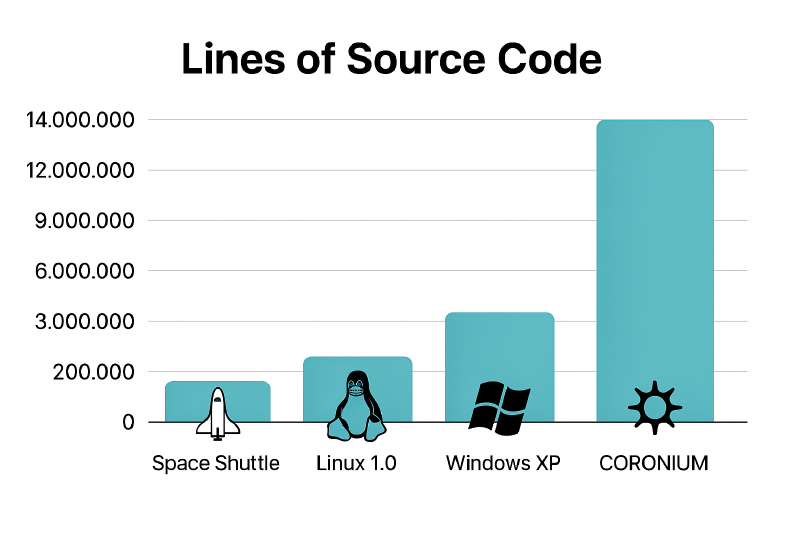
Number of Lines of Source Code
Hello!
Today, I would like to talk about a slightly unusual theme.
It’s about “How much has the number of lines of source code increased compared to the past?”
For example, the space shuttle’s software consisted of about 420,000 lines of code. This code was developed with very strict processes to meet NASA’s high quality standards. On the other hand, in modern large-scale software projects, it is not uncommon for the number of lines of code to exceed tens of millions. For instance, Google’s codebase is said to reach about 2 billion lines.
In this way, the scale of software has grown along with the times.
But, wait a minute.
An increase in the number of lines of code is not necessarily a bad thing. In order to add new features or meet user needs, it is natural for code to increase. However, as the code increases, the risk of bugs also rises. In fact, a study shows that when open source projects exceed 1 million lines, the incidence of bugs tends to increase.
That being said, not all projects are increasing code in the same way.
For example, the Linux kernel had about 200,000 lines in version 1.0 in 1994, but increased to about 20 million lines in version 4.2 in 2015. This increase is to accommodate the evolution of hardware and the addition of new features.
So, the number of lines of source code varies greatly depending on the scale and purpose of the project, as well as the historical context.
The increase in lines of code itself is not a problem, but appropriate management is necessary to maintain quality and maintainability. It is important to understand the risks associated with the increase in code and take appropriate measures.
Finally, I think it’s important not to get too caught up in the number of lines of code, but to focus on the purpose and quality of the project.
Well then, see you next time!